What’s Black and White and Cold All Over? A Lakewood Bachur in the Freezer
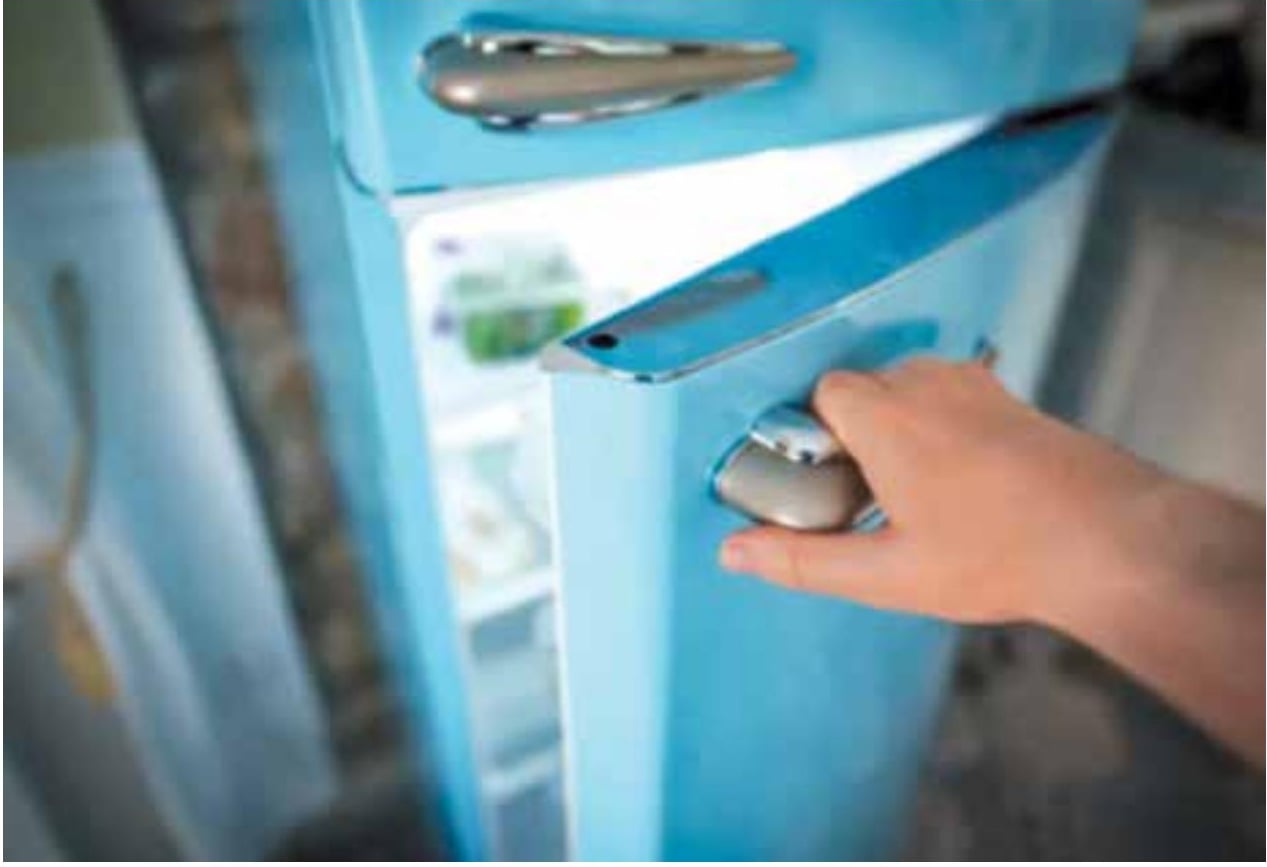
This year, Tu B’Shvat falls out on Shabbos. That means the following story could actually happen: Someone suggests to a Lakewood bachur that he go for a Shabbos stroll as a first date. The bachur responds, “Sorry, I don’t open a freezer on Shabbos.”
Why would someone be on the shelf about opening a refrigerator on Shabbos? Let’s chill for a moment and get to the bottom of this.
When a freezer or refrigerator door is opened, warmer air enters. If the door is left open long enough, the compressor will turn on to bring the temperature back down to the set level. Even if the door is opened only briefly, the warmer air entering the freezer can cause the compressor to turn on sooner than it otherwise would.
Consequently, may one open a freezer door on Shabbos to get his ice cream, or must he wait until “Sundae”? Let’s break the ice.
The Mishnah in Bechoros (24b) discusses preparing a bechor for shechitah. One may push the animal’s hair aside with a knife to make it easier to shecht, even though one might unintentionally shear some of its hair. This would violate the prohibition of “v’lo sagoz bechor tzonecha” (Devarim 15:19).
The Gemara suggests that this may be permitted because we follow the ruling of Rebbe Shimon: If someone performs an action that has an unintended forbidden consequence, the action is still permitted. This is one possible explanation offered by the Gemara.
Rebbe Shimon’s opinion appears frequently throughout Shas. Indeed, the Gemara discusses similar principles elsewhere in Bechoros. One may not intentionally create a mum, a disqualifying blemish, in a bechor. But what if a medical procedure is necessary and might result in a mum? According to Rebbe Shimon, this might be permitted because the blemish is unintended.
Now you know the scoop: getting ice cream from the freezer on Shabbos should be permitted. One intends to open the door but does not intend to turn on the compressor.
However, the Gemara makes an important distinction. If the act will certainly result in the forbidden consequence, it is prohibited. This is known as a p’sik reisha. If moving the hair aside on the bechor will definitely result in shearing, or a medical procedure will definitely result in a mum, Rebbe Shimon may concede that it is forbidden.
Now we can let these ideas thaw out and apply them to our freezer.
Opening the freezer door has the unintended consequence of causing the compressor to turn on sooner than it otherwise would. But here is the problem that could leave us frozen in our tracks: The compressor will most certainly turn on earlier because of the warmer air entering the freezer. This would seemingly qualify as a p’sik reisha.
Rav Shlomo Zalman Auerbach, zt”l, opined that causing the compressor to turn on would, at worst, involve the use of electricity, which is an issur d’Rabbanan. Furthermore, there is usually a time delay between opening the door and the compressor activating. Because of this delay, the action can be considered a gerama, an indirect cause. Rav Shlomo Zalman ruled that one may l’chatchilah cause a gerama of an issur d’Rabbanan. Therefore, one may open the freezer door on Shabbos even though doing so will certainly cause the compressor to activate earlier than it otherwise would.
But this may be just the tip of the iceberg.
Suppose the freezer is set to 5°, and its current temperature is 5.9°. As soon as the freezer door is opened, the temperature rises to 6°, triggering the compressor. In this scenario, there is no time delay. Since the compressor activates immediately, opening the freezer door would seemingly be prohibited even on a rabbinic level.
Since this may always be a possibility, is opening the freezer door on Shabbos akin to skating on thin ice?
True, the person opening the freezer did not intend for the compressor to turn on immediately. But in this scenario, it might definitely happen. This is termed a safek p’sik reisha. The outcome is predetermined: Either the unintended consequence will definitely occur or it will not. The person simply does not know which is the case.
So must we warn the person about to open the freezer door to cool it?
The Taz and the Mishnah Berurah, not being cold-hearted, come to the rescue.
The Taz discusses the following scenario: Someone wishes to close the door of a cabinet that may or may not contain mosquitoes. He would certainly be happy if the mosquitoes were trapped inside, but that is not his intention. He merely wants to close the door for aesthetic reasons. May he close the cabinet door knowing that, if it contains mosquitoes, he will definitely violate the prohibition of trapping on Shabbos? After all, he does not know whether trapping will definitely occur.
The Taz rules that one may close the cabinet door without reservation. One does not have to check whether the cabinet contains mosquitoes. Since, as far as he knows, the prohibition of trapping will not definitely be violated, the action is not considered a p’sik reisha.
But the Taz’s reasoning received a frosty reception in the Mishnah Berurah.
If the cabinet does contain mosquitoes, one will certainly violate the prohibition of trapping. How, then, can one close the door?
Nevertheless, even the Mishnah Berurah ultimately concedes that closing the cabinet door is permitted. Mosquitoes are generally not trapped for use; they are trapped because one wants to get rid of them. Trapping creatures that are usually trapped because they are a nuisance involves only an issur d’Rabbanan. Since there is doubt as to whether any trapping will occur—we do not know whether the cabinet contains mosquitoes—we can apply the principle of safek d’Rabbanan l’kula: In a case of doubt involving a rabbinic prohibition, we are lenient.
Based on the above, there is no need to have cold feet before opening the freezer door on Shabbos.
Most of the time, there will be a delay before the compressor turns on as a result of opening the door. According to Rav Shlomo Zalman, this would be a gerama involving a rabbinic prohibition, which is permitted. Although it is possible that the compressor will activate immediately upon opening the door, there is no way to know this in advance. Since it is only a possibility, the Taz would say that one need not be concerned about it.
The Mishnah Berurah would be concerned if a biblical prohibition were involved. However, since Rav Shlomo Zalman ruled that the halachic issues here involve only rabbinic prohibitions, the Mishnah Berurah would concur that one may open the freezer door on Shabbos.
Therefore, one need not get heated about the prospect of going without ice cream on Shabbos. The situation may be chilling, but the halachic analysis offers some cool comfort!
Still, there are those who open the freezer on Shabbos only when the compressor is already running. Others will not open the freezer on Shabbos at all. Moreover, this article has addressed only the thermostat issue. There may be other considerations, such as lights and sensors, that also need to be addressed.
So what’s black and white and cold all over? A Lakewood bachur who is still waiting for a definitive ruling before opening the freezer!
More Gemara stories
Questions on this article

Rabbi Avrohom Sebrow
Rebbe at Yeshiva Ateres Shimon in Far Rockaway. He leads the Daf Yomi chaburah at Eitz Chayim of Dogwood Park in West Hempstead, and writes “Delving into the Daf” each week for The Jewish Home.
About and contact