The Modern Autopen
By Rabbi Avrohom Sebrow • 2/17/2026
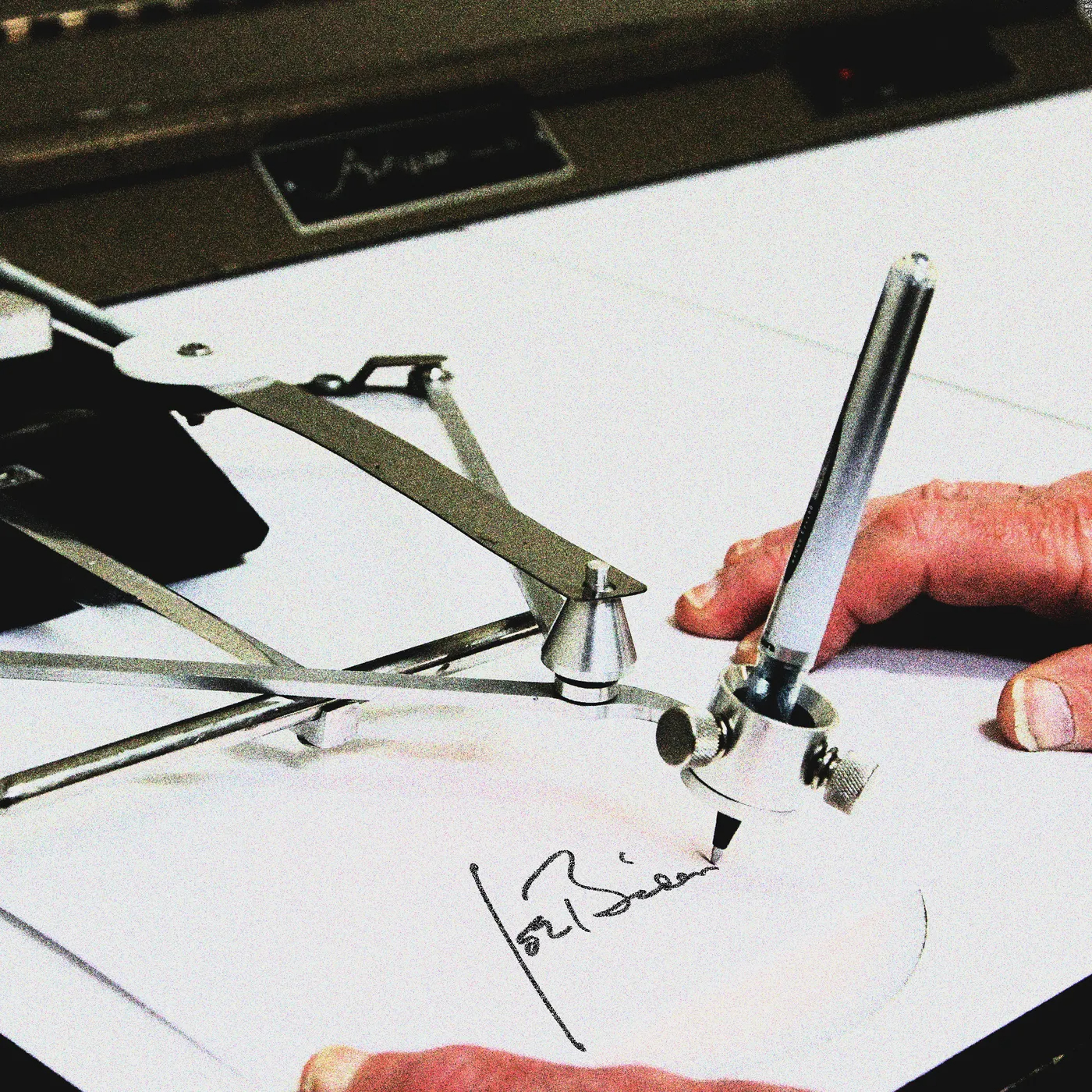
The Presidential Autopen
The presidential autopen is a clever machine that helps the President manage the huge stack of documents requiring a signature each day.
It uses a small, motorized arm holding a real pen to reproduce the President’s signature precisely, ensuring that bills, letters, and photos appear genuinely signed without tying up the President’s extraordinarily busy schedule. Legally, the signature it creates carries the same effect as the President’s own signature when a signature is required on bills.
Recently, this device has been in the news: some have claimed that certain uses of the autopen were unauthorized, rendering the documents in question legally problematic.
An Ancient Autopen?
Although this sounds like a modern invention, an analogous “autopen” may have existed thousands of years ago.
To see why, we begin with a passage in Menachos (30a). The Gemara there states that a special halacha applies specifically to the last eight pesukim of the Torah.
There is much disagreement about the exact nature of that halacha:
* Some say that all eight pesukim must be read in a single aliyah.
* Others suggest that for these pesukim, a ba’al korei may not read aloud together with the oleh.
* Some assert that these pesukim do not even require a minyan.
* Perhaps the most conventional p’shat is that the honor of being called for these eight pesukim is reserved for the most accomplished scholar.
Rebbe Yehuda (or, according to some, Rebbe Nechemia) explains that the last eight pesukim are different from the rest of the Torah, which Moshe wrote himself. According to this view, Yehoshua completed the final eight pesukim that discuss the death of Moshe.
Rebbe Shimon takes strong exception. The Torah itself refers to Moshe Rabbeinu handing over a Sefer Torah — and that Sefer Torah was certainly complete. Rather, Rebbe Shimon maintains that Moshe Rabbeinu himself wrote the last eight pesukim, but he wrote those words with tears.
In either case, both opinions agree that something unique attaches to the final eight pesukim — hence the unique halacha.
The Problem: Writing on Shabbos
Rav Sar Shalom Gaon held that the recitation of Tziduk HaDin (which, in Nusach Ashkenaz, begins with “Tzidkascha Tzedek”) after the Chazaras HaShatz of Mincha on Shabbos commemorates the passing of Moshe Rabbeinu. This was even marked by a custom to avoid scheduling public discourses during that period.
But Tosfos raises a difficulty: how could Moshe Rabbeinu have died on Shabbos?
The Torah states, “I am 120 years old today.” Chazal interpret this as meaning that he completed his life and died that same day. If so, he would have written that pasuk in the Sefer Torah on Shabbos.
Tosfos suggests that perhaps he wrote that pasuk on Erev Shabbos. Yet Rebbe Shimon will not concede that the Torah can record a future handover of a complete Sefer Torah; he contends that events written in the Torah occurred or would occur that day. If Moshe died on Shabbos, then he wrote on Shabbos.
How could he have violated Shabbos?
Tosfos therefore disagrees with Rav Sar Shalom Gaon and concludes that Moshe Rabbeinu died on Friday and was buried by Hashem on Shabbos.
The Shelah HaKadosh’s Defense
The Shelah HaKadosh defends Rav Sar Shalom Gaon. Moshe did not write the Sefer Torah himself in the normal way; he used an “autopen” called hashbuas kulmus.
Moshe Rabbeinu, versed in the hidden secrets of Torah and the forces of nature, employed miraculous means to cause the pen to write the words of the Sefer Torah.
Indeed, a Midrash states that Moshe wrote thirteen sifrei Torah on the day of his death. How else could he have managed such a feat except by animating the pen through kabbalistic forces?
Supernatural Writing
HaRav Asher Weiss observes that a Sefer Torah must be written by a person to be kosher. The writing produced by Moshe’s animating of the pen was, in that sense, considered to have come from Moshe Rabbeinu — and yet was permitted on Shabbos.
One explanation is that writing performed through supernatural means counts as a shinui — an abnormal method — and therefore does not violate the Torah prohibition of writing on Shabbos while still producing a kosher Sefer Torah.
By analogy, writing with the left hand is only rabbinically forbidden on Shabbos because it is not the normal way to write; nevertheless, a Sefer Torah written with the left hand is still kosher.
The Maan Question
HaRav Daniel Alter, a (less-famous) son of the Pnei Menachem, raises a question about an apparent contradiction between the Shlah and a comment of the Moshav Zekeinim, a compilation of Baalei Tosfos’ remarks on Chumash.
The Torah says (Shemos 16:23):
“He said to them, ‘This is what Hashem meant: Tomorrow is a day of rest, a holy Sabbath to Hashem. Bake what you will bake and boil what you will boil; and all that is left put aside to be kept until morning.’”
These are instructions for the maan: the Bnei Yisrael were commanded to prepare the maan before Shabbos.
The Moshav Zekeinim asks: that prescription is understandable for ordinary food, but what preparation did the maan require? The maan responded to one’s thought; one merely imagined the flavor one wanted, and that was enough.
What precisely were the people warned not to do on Shabbos but commanded to do before Shabbos?
The Moshav Zekeinim answers that the maan required a verbal declaration, and that declaration prepared it. It was akin to making food edible on Shabbos. Therefore, declaring on Shabbos that the maan should taste like a particular food would be a Shabbos violation.
HaRav Alter points out that this seems to conflict with the Shlah’s position. If the Shlah permits Moshe’s use of supernatural forces to write the Torah — not a Shabbos violation — then how can invoking supernatural means to make maan edible be forbidden?
Resolution
An answer based on Rav Alter’s resolution is as follows:
What Moshe did to animate the pen qualified as a shinui — an abnormal act — and therefore was not a Torah-level prohibition.
By contrast, the mechanism built into the man — the way it became edible when one made the verbal declaration — was the normal, intended way to prepare it. Using that mechanism on Shabbos would therefore be a Torah-level violation.
Practical Halacha: Supernatural Melacha
How do we pasken from these sources? May one use supernatural means to perform melacha on Shabbos?
Surprisingly, this issue appears in the Shulchan Aruch and the Mishnah Berurah.
The Shulchan Aruch (Orach Chaim 328:45) rules that one may use an incantation to immobilize snakes and scorpions on Shabbos; this is not considered the biblical melacha of trapping.
The Mishnah Berurah clarifies that in this case there is only a chashash rechoka — a distant concern — that the creatures might inflict harm. Nonetheless, it is permitted because one is not trapping in a normal, natural way.
The Steipler explains that trapping by supernatural means is considered a shinui. Although generally the rabbanim forbade relying l’chatchila on a shinui, they did not enact that decree here.
His son, Rav Chaim Kanievsky, offered an alternate reason: the Torah forbids performing melacha on Shabbos with one’s body, but speaking is not classified as a melacha. That distinction, if accepted, leads to a very different practical result.
Speaking to Machines on Shabbos
Applied to modern technology: can one speak to a computer or device and thereby have it perform melacha?
According to the Steipler’s approach, one may not — because using a computer is not a shinui; it is performing melacha in a normal way.
According to Rav Chaim Kanievsky’s approach, however, one might be permitted at least on a Torah level, since speech itself is not the forbidden bodily act of melacha.
Indeed, one well-known talmid chacham advised a doctor to purchase a self-driving car for use in Shabbos emergencies.
Remaining Rabbinic Concerns
Even following the lenient approach, there may still be rabbinic issues when speaking to a computer, such as:
* Uvda d’chol (weekday-type activity)
* V’daber davar
Finally, Rav Yitzchak Zilberstein relates that he once asked Rav Chaim Kanievsky whether, if one has ample time, there is any advantage to using a voice-activated telephone in an emergency on Shabbos rather than a regular telephone. Rav Chaim responded that he was unsure.
It is remarkable how teachings and Midrashim from so many centuries ago can suddenly feel tailor-made for today’s newest technologies. The devices may be modern, but the Torah’s wisdom continues to speak directly to the questions of every generation.
Topics
Presidential autopen autopen controversy ancient autopen in Torah Menachos 30a last eight pesukim Moshe Rabbeinu last eight verses writing on Shabbos halacha Tosfos on Moshe’s death Shelah HaKadosh hashbuas kulmus supernatural writing in Judaism shinui on Shabbos Sefer Torah writing laws Midrash Moshe thirteen sifrei Torah maan preparation on Shabbos Moshav Zekeinim on maan Shulchan Aruch Orach Chaim 328:45 Mishnah Berurah on trapping incantations on Shabbos halacha Steipler Gaon shinui explanation Rav Chaim Kanievsky speech and melacha Rav Asher Weiss Sefer Torah Rav Yitzchak Zilberstein Shabbos technology voice activated devices on Shabbos speaking to machines on Shabbos self driving car Shabbos emergency technology and halacha contemporary Shabbos questions melacha through speech Torah and modern technology