Pasta Imposter
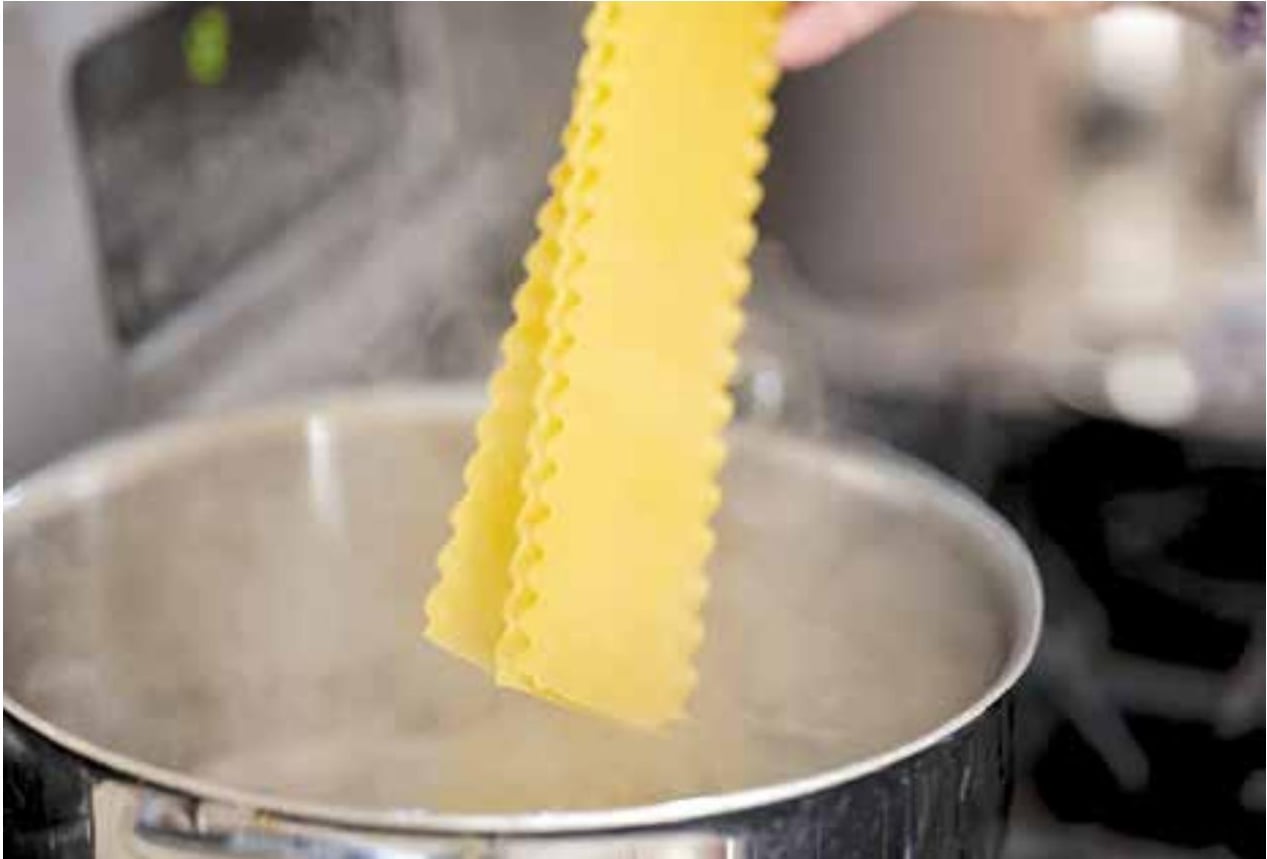
Miriam strolled into the pasta aisle, wheels turning on her cart and in her head. Tonight was lasagna night, and she was ready to make a great meal.
Her eyes landed on the familiar blue Ronzoni boxes. On the left: regular lasagna noodles, patiently waiting for their turn in boiling water. On the right: oven-ready noodles, boldly declaring, “No boiling required!” Miriam smirked. “Well, aren’t you full of your own sauce,” she muttered.
Skipping the steamy noodle shuffle was tempting. But then she noticed the fine print—the kosher symbols. The oven-ready box bore a hechsher with a “K,” while the regular box proudly carried an OU.
“Ah,” she said aloud, “so that’s the pasta point of no return.” She reached for the OU-certified noodles with a smile.
Why doesn’t Ronzoni’s oven-ready lasagna carry an OU? The answer lies in the laws of bishul akum, discussed in Avodah Zarah. Chazal forbade a Jew from eating food cooked by a non-Jew, even if every ingredient is kosher. This decree applies when two conditions are met:
1. The food is not edible raw.
2. The food is important enough to be “fit for a king’s table.”
Lasagna noodles meet both conditions, so bishul akum applies. Oven-ready noodles are essentially precooked pasta. Though dehydrated for shelf life, they are already edible straight from the box. Since they are not cooked by a Jew, they should technically fall under bishul akum and be forbidden.
Rav Moshe Feinstein, zt”l, however, suggested a leniency. He argued that bishul akum is only a concern when ordinary cooking by a gentile could lead to social interaction. Ordinarily, Chazal did not allow exceptions to their decrees. However, Rav Moshe argued that when the cooking is done with specialized equipment and the process is far removed from ordinary kitchen practice, the rule of lo plug does not extend to it.
Based on this logic, oven-ready noodles could be permitted. Still, the OU will not rely solely on Rav Moshe’s heter. They only use it in combination with another leniency. Since no such additional factor exists here, the OU does not certify Ronzoni oven-ready lasagna. Another agency, however, is comfortable relying on Rav Moshe’s reasoning alone and therefore gives certification.
This issue also connects to another halachic discussion: making instant noodle soup on Shabbos.
At one summer camp, it was common for boys to prepare noodle soups on Shabbos that contain ramen. Ramen noodles, like oven-ready pasta, are pre-cooked and technically edible as is—kids do snack on them dry. Thus, reheating them in hot water should not be considered cooking, because of the principle ein bishul achar bishul b’yavesh (a dry item that was cooked cannot be cooked again).
However, some manufacturers don’t actually boil their noodles; instead, they steam them. In such a case, the product may be considered steamed or baked rather than cooked. Halacha is stringent that one may not cook a baked item on Shabbos (yeish bishul achar afiyah). Tosafos (Avoda Zara 74b) holds that water straight from an urn (kli rishon) can still cook a thin layer (k’dei klipah) of food. Therefore, practically, one may not rehydrate ramen with boiling water directly from the urn.
Complicating things further, the spice and vegetable packets often contain uncooked ingredients, which makes direct pouring even more problematic. The practical solution is to use a kli shlishi (a third vessel). One fills a cup from the urn, pours it into a second empty cup, and only then adds the noodles and flavoring. The boy can likewise pour that second cup into his noodle soup. But both options rely on Rav Moshe Feinstein’s opinion that “there is no bishul in a kli shlishi,” a ruling not universally accepted.
As an aside, the Mishnah Berurah seems to imply that if someone mistakenly prepared an instant noodle soup with the spice packets on Shabbos directly from the urn, the food may not be eaten. But if he poured the spice packets into a kli sheini (second vessel), it would be permitted. The Dirshu edition points out that this ruling appears to contradict the Chofetz Chaim’s stance elsewhere, where both cases should theoretically be permitted bedi’eved.
From Ronzoni to ramen, the halacha of bishul akum and Shabbos cooking teaches us that no bite is too small for careful thought. Each noodle on our plate is a reminder that even the simplest foods are seasoned with halacha.
More Gemara stories
Questions on this article
Rabbi Avrohom Sebrow
Rebbe at Yeshiva Ateres Shimon in Far Rockaway. He leads the Daf Yomi chaburah at Eitz Chayim of Dogwood Park in West Hempstead, and writes “Delving into the Daf” each week for The Jewish Home.
About and contact