Hair-Raising Thoughts
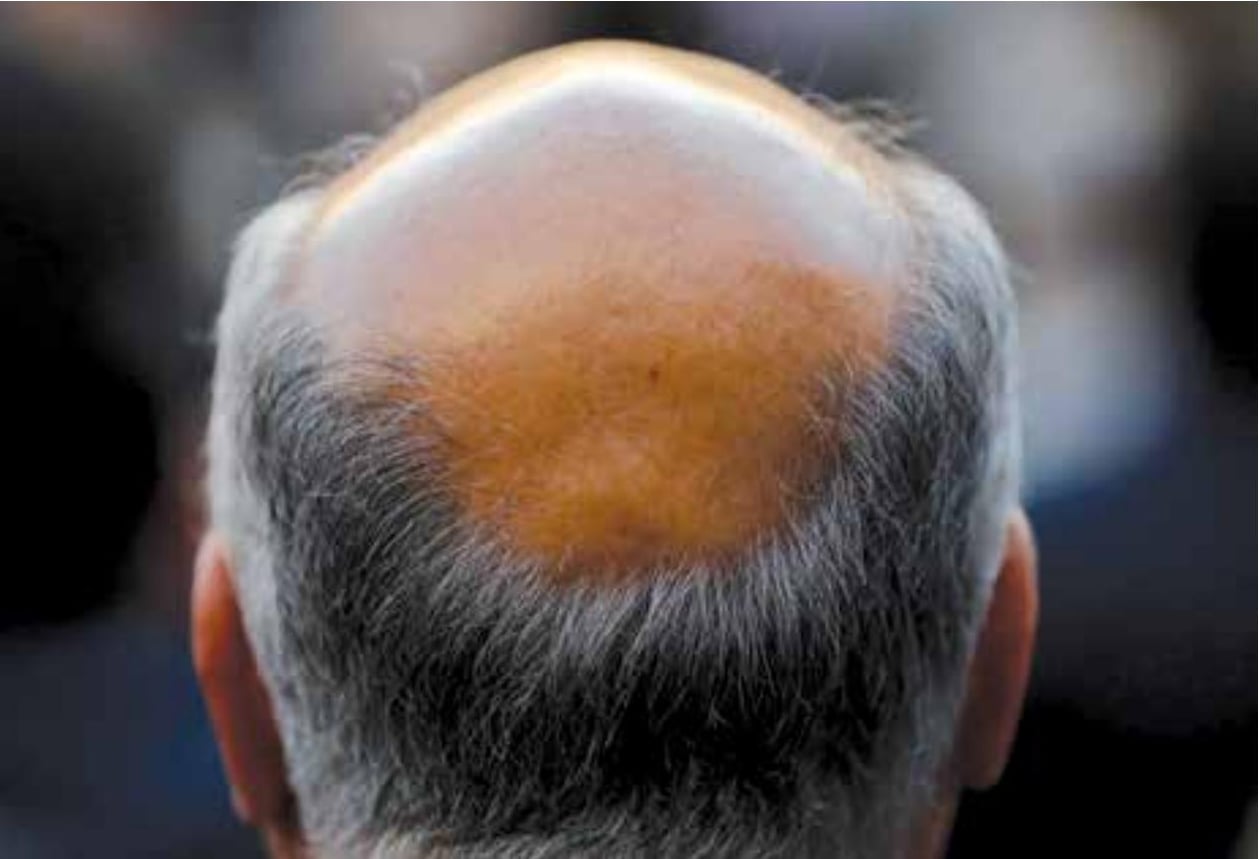
Male pattern baldness is a common experience for many men. Some individuals embrace their baldness and even display signs in their office, like “G-d created a few perfect heads. The rest He covered with hair.” Others try to conceal their bald spots. A common one-liner is: “How do you identify a bald eagle? It has all its feathers combed over to one side.” Some may attempt to hide their bald spots by combing over hair from a different section of their head.
Former New York City Mayor Rudy Giuliani used to employ this tactic. However, one day, he famously gave up his comb-over hairstyle. Rushing one morning in the midst of a busy schedule, Giuliani didn’t bother with the more time-consuming coiffure and simply combed his hair straight back.
The positive reaction was immediate. Favorable reviews started coming in from the press. The Washington Post dedicated a six-column spread to Giuliani’s new look, complete with before-and-after photos. The Post praised him for “allowing his scalp to rise – unashamed – from a ring of smooth, graying fringe.”
What is the Gemara’s view; is calling someone bald derogatory?
The Gemara mentions the saintly Tanna Rebbe Yehoshua ben Korcha (Bava Basra 113). Korcha literally translated means “bald one.” He is not one of the more common Tannaim mentioned in the Talmud; therefore, Tosfos discuss the identity of this Rebbe Yehoshua ben Korcha. Rabbeinu Yitzchak hypothesizes that Rebbe Yehoshua was the son of Rebbe Akiva.
It is known that Rebbe Akiva had a son named Yehoshua. The Gemara in Shevuos (6a) records a conversation that took place between Rebbe Akiva and a son named Yehoshua. Still, why would Rebbe Akiva be referred to as “bald one”? Was he, in fact, bald? Rabbeinu Yitzchak says he was. Ben Azzai once jovially declared: “All the Sages in the world are like a peel of garlic compared to me except for this bald one.” Apparently, he was referring to Rebbe Akiva. Therefore, knowing that Rebbe Akiva was bald and had a son Yehoshua, it can be surmised that Rebbe Yehoshua ben Korcha is none other than Rebbe Akiva’s son.
Rabbeinu Tam emphatically disagrees. He says that referring to someone as bald is derogatory. As proof, he cites the verse in Melachim, where some youths referred to Elisha HaNavi as “the bald one.” The youths were immediately punished. Bears miraculously appeared and mauled them. Further, a Gemara in Shabbos records a statement where someone derogatorily referred to someone as bald. Moreover, there is no proof that Rebbe Akiva was actually bald. A midrash states that Ben Azzai was jovially referring to Rebbe Elazar ben Azariah, not Rebbe Akiva, by the moniker “bald one.”
Finally, he argues that an incident involving Rebbe Yehoshua ben Korcha and Rebbe Yehuda HaNasi seems to make it impossible that he was Rebbe Akiva’s son.
Rebbe Yehuda HaNasi was born when Rebbe Akiva passed away. Yet when Rebbe Yehoshua ben Korcha, already at a miraculously advanced age, met up with Rebbe Yehuda HaNasi (Rebbe), he was significantly more than double Rebbe’s age, which does not compute. (See Tosfos for details.)
Rabbeinu Tam therefore concludes that Rebbe Yehoshua ben Korcha was not Rebbe Akiva’s son but a different Tanna who was the son of individual who had the name Kerach. It is interesting to note that the Chida quotes a Kabbalist who states that he had a vision of both Rebbe Yehoshua ben Korcha and Rebbe Yehoshua ben Rebbe Akiva. The Kabbalist noted that they are definitely not the same person!
The sefer Ramas Shmuel defends Rabbeinu Yitzchak’s position. He suggests that Korcha or “kerach” did not refer to physical baldness. It referred to the fact that Rebbe Akiva was left bereft of his 24,000 talmidim. We find in Shas that the term “kerach” refers to something that is missing; a “get kerach” is a document missing the requisite number of signatures. Rebbe Akiva was missing his 24,000 students. Unfortunately, they perished as an act of Divine retribution for not according each other proper deference. Rebbe Akiva did not mind the moniker “Korcha” because it was a backhanded praise that he was great enough to have had 24,000 talmidim. More importantly, it was an ongoing reminder to remember the lesson of those 24,000 students.
We might forget the powerful lesson of the importance of treating our peers with an elevated level of respect. Referring to Rebbe Akiva as Korcha serves as an eternal reminder of that lesson. Every time we come across the name Korcha, we should take the opportunity to eternalize the lesson that even great scholars are not spared if they do not treat each other cordially.
At the same time, we should recall that Rebbe Akiva’s new students, though they numbered only five, were enough to keep the transmission of Torah alive. Quality is as important as quantity.
More Gemara stories
Questions on this article
Rabbi Avrohom Sebrow
Rebbe at Yeshiva Ateres Shimon in Far Rockaway. He leads the Daf Yomi chaburah at Eitz Chayim of Dogwood Park in West Hempstead, and writes “Delving into the Daf” each week for The Jewish Home.
About and contact