Small Talk
Jay Shafer has been living in a house smaller than some people’s closets since 1997. His decision to inhabit just 89 square feet arose from his concerns about the impact a larger house would have on the environment. Wishing to share this experience with others, he started the Tumbleweed Tiny House Company. They have made the most of each cozy interior by minimizing transitional areas like hallways and stairwells and by using otherwise unusable space as storage. While his personal house is 89 square feet, he sold a smaller house, the XS model. It has a whopping 65 square feet of living space.
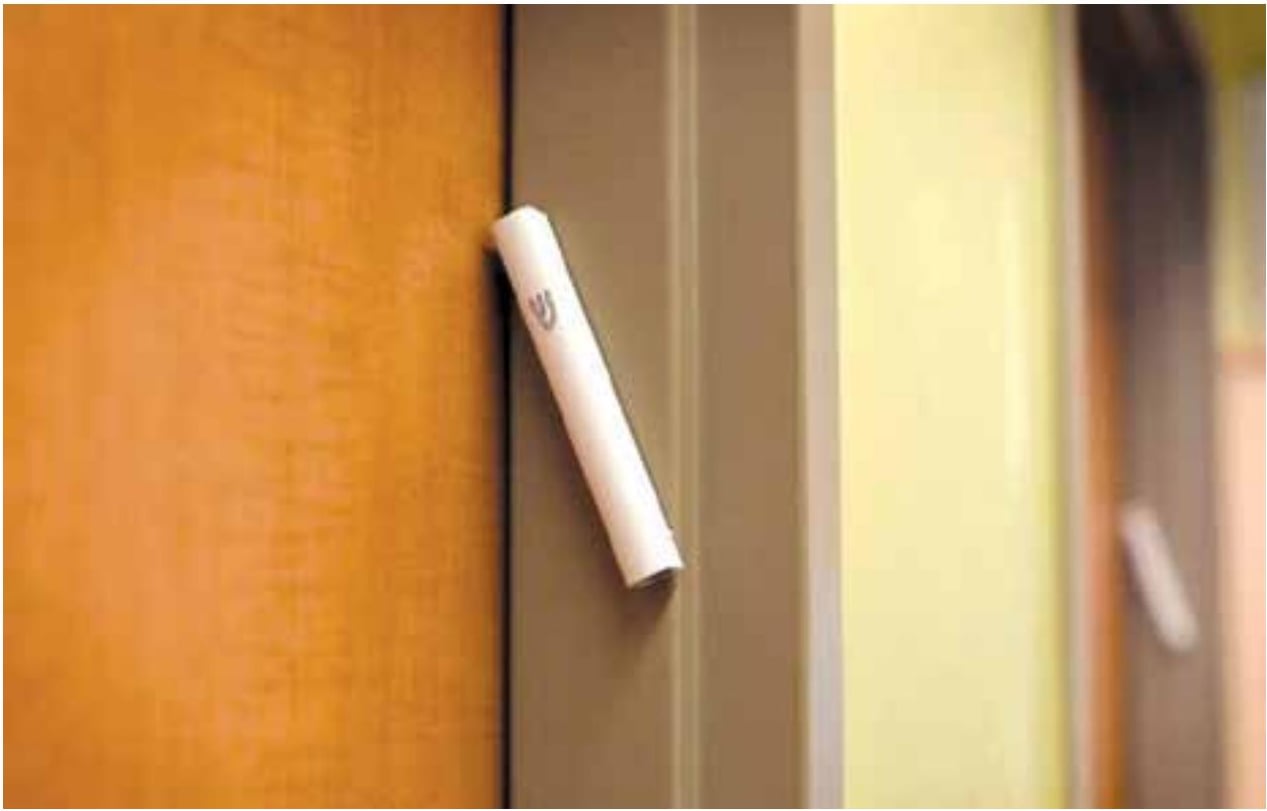
If one purchases such a small house, must he put a mezuzah on the front door? The Gemara in Succah 3a states, “A house that does not contain an area of four amos by four amos is exempt from mezuzah, maakeh and is not contaminated by tzaraas…” Even if one used the largest possible measure of amah, the XS 65 sq. foot house would still be obligated in mezuzah. Assuming an amah is two feet, the minimum shiur for mezuzah would be a house that is eight-by-eight or sixty-four square feet. The XS meets that minimum with a square foot to spare!
There is one caveat. The Chazon Ish ruled that if permanently installed furniture takes up some of the floor space, reducing the living space to below the minimum requirement, a mezuzah is unnecessary. Therefore, if the minimum living space required to be obligated in the mitzvah of mezuzah is 64 sq. feet, the XS would not qualify. Nevertheless, the accepted custom in America is to follow R’ Moshe’s opinion. He says an area of four-by-four amos is around 49 sq feet. The XS model still might not require a mezuzah with a bracha since some of the space is taken up by unmovable furniture.
The next question we must consider is whether the sixteen square amos is a requirement for an entire house or even for a room. When stating the four square amos requirement, the Gemara clearly says “bayis,” a house. Are tiny rooms in a large house obligated in mezuzah? According to the Maharam Shik, the answer depends on a machlokes surrounding a Gemara in Bava Basra 61a.
The Mishna discusses a situation where one sold a house without specifying precisely what was included in the sale. The Mishna says that if the house in question has a small structure nearby, that structure is not included in the sale unless specifically mentioned. Mar Zutra comments that only if that small structure is a minimum of sixteen square meters is it not included in the sale. If, however, it is smaller than that, then the structure is deemed insignificant and included in the house sale. The Mishna further states that if the house has an adjoining storage room, it is also not included in the sale. Mar Zutra did not clearly state whether or not there is a requirement for the room to be sixteen square amos to be excluded from the sale. Perhaps even a room that is less than sixteen square amos is significant enough to be excluded from the sale unless specifically included.
The Maharam Shik says that this dispute would apply to mezuzah as well. Does a room need to be sixteen square amos to be obligated in mezuzah, or perhaps any size room that is part of a larger house is considered usable and significant?
The Pische Teshuva (286:11) quotes the Chamudei Doniel that a storage room in a larger house requires a mezuzah even if it is less than sixteen square amos. According to this opinion, any walk-in closet or balcony would be obligated in mezuzah regardless of size. The closet or balcony is considered a usable room for its intended purpose and consequently is obligated in mezuzah.
Rebbe Akiva Eiger does not accept the ruling of the Chamudei Daniel. However, he suggests that a mezuzah is required on the doorway of a walk-in closet because that doorway is significant since it leads into a large room.
The practical difference between the Chamudei Daniel and Rebbe Akiva Eiger is on which side of the doorway to affix the mezuzah. According to the Chamudei Daniel, it is affixed on the right side as you enter the walk-in closet. According to Rebbe Akiva Eiger, it is affixed on the right side as you enter into the large room from the walk-in closet. This distinction is crucial in understanding the debate.
In order to accommodate both perspectives, one potential solution is to place a mezuzah on each doorpost. However, this option is not permissible because it could be viewed as baal toseif, which means adding to Hashem’s commandments in an unauthorized manner. This action might give the impression of unlawfully expanding upon Hashem’s mitzvos.
Therefore, one has to choose whose opinion to follow. The Minchas Yitzchak advised following the Chamudei Daniel. Rav Chaim Kaniebsky advised following Rebbe Akiva Eiger based upon the ruling of the Chazon Ish. Rav Moshe Feinstein, zt”l, ruled that one does not need to affix a mezuzah because the opinions of the Chamudei Daniel and Rebbe Akiva Eiger are not accepted as practical halacha.
For practical halacha, one is strongly encouraged to seek guidance from a posek or rav. Their expertise and understanding of the halacha will provide the necessary clarity and reassurance in navigating the application of mezuzah in small living spaces.
More Gemara stories
Questions on this article
Rabbi Avrohom Sebrow
Rebbe at Yeshiva Ateres Shimon in Far Rockaway. He leads the Daf Yomi chaburah at Eitz Chayim of Dogwood Park in West Hempstead, and writes “Delving into the Daf” each week for The Jewish Home.
About and contact