What’s in a Name?
The Gemara in Bava Basra 91a provides material for some good trivia questions. What was the name of Avraham Avinu’s mother? What was the name of Dovid HaMelech’s mother? Which famous biblical personality has a sister whose name we know but is not mentioned anywhere in Tanach?
The Talmud states: “Rav Chanan bar Rava further stated in the name of Rav: The name of Avraham’s mother was Amasla’i, the daughter of Karnevo; the name of Haman’s mother was Amasla’i, the daughter of Orvasi…. The mother of Dovid was named Nitzevess, the daughter of Ada’el. The mother of Shimshon was named Tzelelponis, and his sister, Nashyan. In what respect does this matter? In respect of a reply to the heretics.”
The Shevet Mussar writes that Nimrod saw through astrology that a male child would be born who would rebel against him and his religion. He therefore decreed that all boys born at that time should be killed. Avraham Avinu’s mother had a boy and successfully hid him. As a token of gratitude for her actions, her name is mentioned in the Gemara. It is well known in some circles that uttering the name of Avraham Avinu’s mother is a segulah when standing in front of a judge or office for any type of determination. This segulah is based on the Chida.
The Gemara ends the discussion of names by raising a question of why this matters. The Gemara answers: “In respect of a reply to the heretics.” The Rashbam clearly understood the question and answer to be regarding all the names. Heretics will ask us if we know those particular names – and we will have an answer. This is especially true regarding the mother of Shimshon, who is regarded by many heretics as a prophetess. However, the Maharsha points out that no heretic would ever ask the name of Shimshon’s sister. She is not mentioned anywhere in Tanach. Why, then, does the Gemara mention her name?
Rav Yaakov Kamenetsky, zt”l, said the name was mentioned as an answer to the heretics. Someday, someone will suggest that it’s possible to have a baby without any father. They will cite this story of Shimshon as a proof. An angel speaks to Shimshon’s mother, and she later becomes pregnant. In turn, we will cite the Midrash (Parshas Naso) that the angel told her that she would have a baby together with her husband. And as further proof that the couple was not in fact sterile, we will cite this Gemara that says Shimshon had a sister. The heretic may choose to believe what he believes, but the Gemara was making clear that Shimshon had a biological mother and father.
Years ago, Mesivta Chofetz Chaim brought in the famed Arachim seminar (like the Discovery Program), at that time led by Rav Shaya Cohen, shlita, to speak to the 11th- and 12th-grade talmidim. It was inspiring, informative, and life-changing. This was not a one-day affair but lasted an entire week. At any rate, all the students were glad to be listening to entertaining speeches about Yiddishkeit rather than performing mundane classwork.
When the discussion turned to other religions, a presenter posed the following question: If a “savior” is born without a physical father, how could he be descended, generation after generation, from King David? It seems to be in conflict with the idea that their savior had no biological father, especially since one of the books in the “New Testament” states that their savior’s father was Joseph. Despite this discrepancy, their standard answer is that the savior adopted the tribe of his adoptive father.
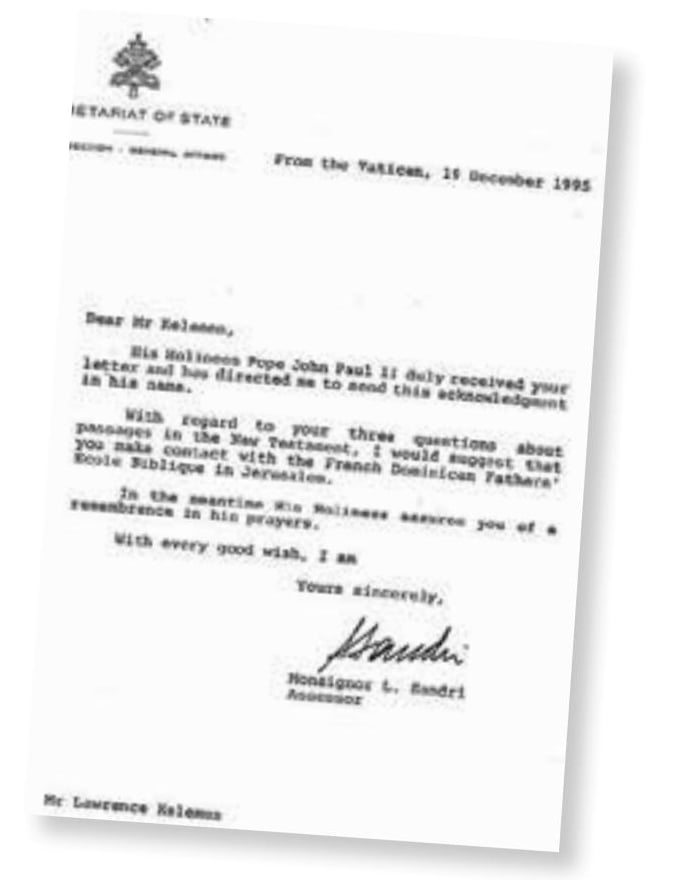
Rabbi Lawrence Kelemen sought to find the official response to this question and others. This question was the third one he asked. Where does one turn to on such matters? He wrote to the pope and asked him directly! The Vatican duly responded in December 1995. They told him to write to the French Dominican Fathers’ Ecole Biblique in Jerusalem. Undeterred, Rabbi Kelemen proceeded to do so. In January 1996, he received a reply that he should look in the books authored by Raymond Brown. He next wrote to Raymond Brown, who basically told him to just get his book. His books have “Nihil Obstat and Imprimatur” approvals, which are official declarations that the book is free of doctrinal or moral error. (The letters from the book Permission to Receive are printed here with the permission of Rabbi Lawrence Kelemen.)
The final answer? An admission that the concept of the fatherless baby was invented. Faced with a choice of admitting to an inappropriate relationship or inventing a “miraculous” birth, their religion chose the latter. (The Rambam, in fact, writes that Miriam was married to Fuhpoos, son of Yehuda, and she had a relationship with a non-Jew.) Some would view their savior’s status as a mamzer favorably, demonstrating that one could rise up against all challenges, even an ignoble birth. Yet for the masses, it was preferred to create the idea of a miraculous birth to make their savior more palatable.
More Gemara stories
Questions on this article
Rabbi Avrohom Sebrow
Rebbe at Yeshiva Ateres Shimon in Far Rockaway. He leads the Daf Yomi chaburah at Eitz Chayim of Dogwood Park in West Hempstead, and writes “Delving into the Daf” each week for The Jewish Home.
About and contact