A Kosher K-Cup
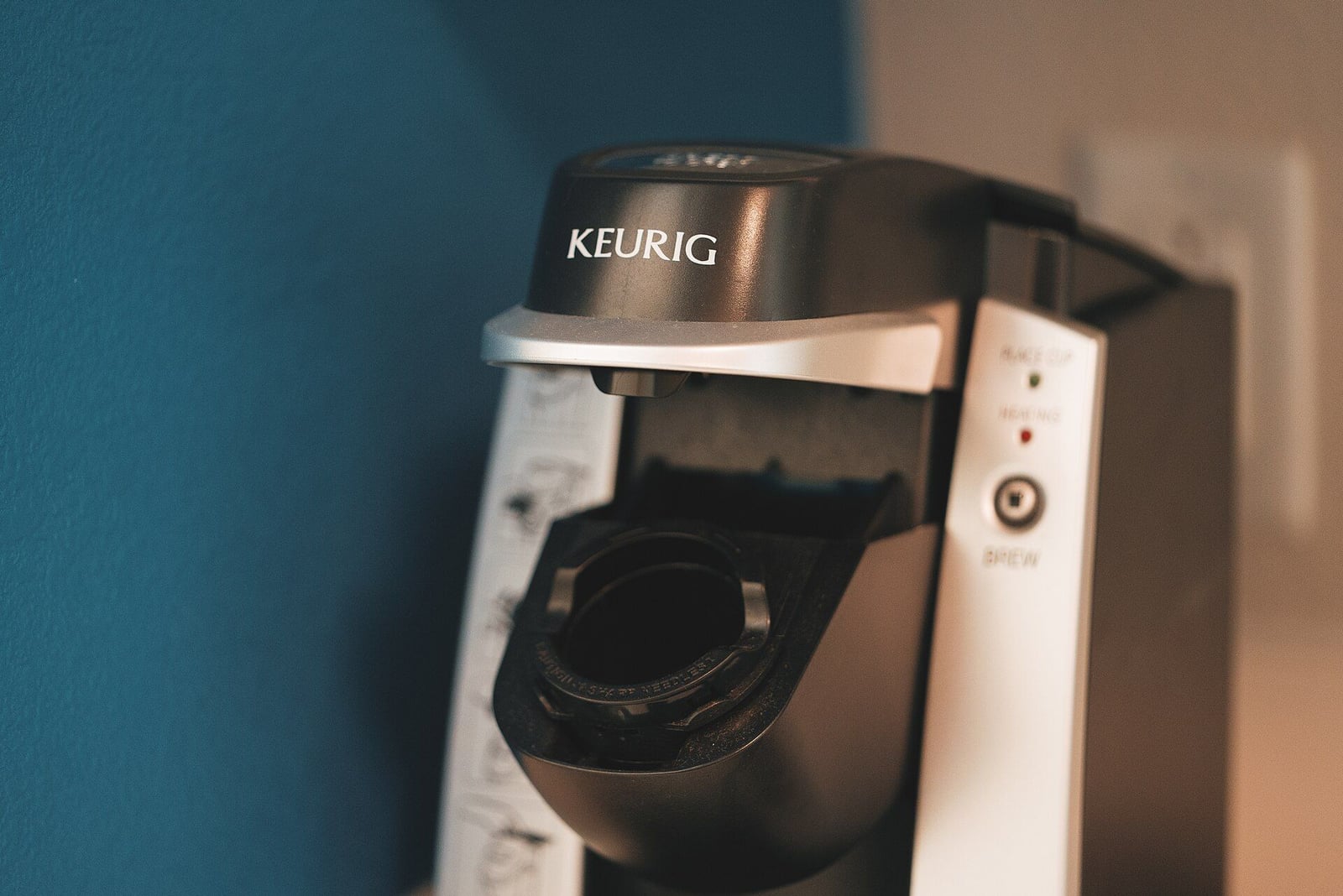
All those people who thought that their Keurig was the best coffeemaker are in for some bad news. The old machine is now just second-class. Keurig introduced a new machine just in time for Pesach. It’s called the Vue and it’s supposed to provide more brewing options to customize your coffee. The OU posted on its website that there are kosher l’Pesach K-Cups. They do not have special Passover certification but are kosher l’Pesach all year round. Flavored K-Cups may contain chametz; consequently, the machine used year round should not be used for Pesach. The article posted by the OU also discusses another issue affecting Keurig machines: tevillas keilim.
There is a biblical mitzvah to immerse in a mikveh utensils used with food prior to use. Metal utensils are definitely included in the mitzvah. Glass utensils require tevillah mi’d’rabannan. Our custom is not to toivel plastic. I am told that minhag Chabad requires tevillah for plastic as well.
An informal and unscientific survey I conducted yielded that the vast majority of people do not toivel their Keurig machines. Many I spoke to never even thought of the issue. They need to wake up and smell the coffee.
The Keurig machine itself is stamped with the following warning: “DO NOT IMMERSE IN WATER.” When I was a child, these cautionary statements always made me feel proud. “Wow! Enough Jewish people are toiveling their appliances that the manufacturer had to put out a warning about tevillah!”
Apparently, people have tried to immerse their Keurig machine, with the result that it ended up being an oversized paperweight. One friend of mine bought the simplest Keurig machine with no electronic options whatsoever. He let it dry for two weeks after its ritual immersion and it still worked! However, the owner of Sterling Electronics told me that those that attempt to toivel any of the higher-end models will most certainly lose their investment. The immersion also voids the warranty.
A relative of mine who inherited a Keurig machine decided to take it apart and see if there were any metal parts on the inside. He found that the water is heated in a small metal receptacle. It would seem obvious that the machine requires tevillah.
One rav ruled that indeed the Keurig machine does require tevillah. However, he explained that you can quickly immerse the Keurig machine. You do not need to wait until all the insides fill up with water. It is analogous to keeping your mouth closed while you are in the mikveh. As long as the entire outside of your body comes into direct contact with the water, it is considered a valid tevillah even with a closed mouth. The same is true with tevillas keilim. As long as the entire outside of the utensil comes into direct contact with the water, we do not have to be concerned about the inside. The Keurig machine needs tevillah according to this view because of the metal parts on the inside. Yet it suffices to only have the exterior plastic parts come into contact with the water.
However, another rav disagreed. The second rav argued that the metal piece was already a utensil before it was attached to the machine. It is considered a distinct utensil and requires tevillah. In fact, even if one were to submerge the entire Keurig machine in water for ten minutes, it might not suffice. How can one guarantee that there weren’t any air bubbles in the small metal receptacle? It is a clear halachah in Shulchan Aruch that even air bubbles are a chatzitzah.
Some argue that there is a clever way to obviate the need for tevillah on the Keurig machine. The Shulchan Aruch (Yoreh Deah 120) rules that one may not immerse a new utensil in a mikveh on Shabbos. (See also O.C. 323.) There is a rabbinic restriction against tevillas keilim on Shabbos because it is akin to repairing a utensil. It is forbidden to use a utensil, even temporarily, before tevillah (contrary to the common myth). When one immerses a utensil in the mikveh, he is rendering it usable. It appears to be a violation of mesaken mana, fixing a utensil, so the rabannan forbade it.
If one must use the new utensil on Shabbos, the Shulchan Aruch offers the following advice: Give it to a non-Jew and borrow it back. Only utensils owned by a Jew require tevillah. Hence, you may use a non-toiveled kosher glass owned by a gentile without a problem. (In a hotel, for example, you may use the clean glasses provided in the room to drink cold water.) You may use your borrowed utensil on Shabbos without tevillah, since it is owned by a non-Jew.
If you are on a hike and can’t be toivel your new grill, you may use the same technique. Give it to a goy and borrow it back. Some people employ this leniency with their Keurig machines; they sell it (or part of it) to a non-Jew and borrow it back. However, this would appear to be problematic. The Taz writes clearly that aforementioned idea is only a temporary solution. One must be toivel the utensil as soon as the opportunity arises. In the Shulchan Aruch’s case, one has to immerse the utensil in a mikveh on Sunday. One is not allowed to permanently keep a gentile’s utensil in his house and use it without tevillah.
So how could one employ this technique with his Keurig machine on a permanent basis? Possibly, one could argue that the Taz only requires immersion at the first available opportunity. In this case, there is no available opportunity. The Keurig machine will break if he tries to immerse it. Perhaps in such a case, the Taz would be lenient and allow one to employ this technique permanently. However, it appears that there is no basis to support this theory, and many reject it. But others argue the opposite extreme and say that a utensil which will break if immersed does not have a tevillah obligation at all. One does not even need to give it to a gentile.
If the utensil was manufactured by a Jew it does not require immersion. Theoretically, disassembling the Keurig machine and reassembling it may be an option. To satisfy all opinions, the metal receptacle used to heat the water would have to rendered unusable. That would certainly be difficult. Some argue that merely plugging in an electric machine is akin to manufacturing it, because plugging it in renders it usable. However, this appears to me to be faulty logic. The metal receptacle could hold water even if not plugged in. Consequently, even if it didn’t heat water it would still require tevillah.
If one permanently attaches the Keurig machine to his house, it would not require tevillah. It is a clear halachah that items that are attached to the ground do not require tevillah. Being attached to the house, which is anchored to the ground, is also sufficient. The question arises as to what is considered “attached.” There is a very lenient opinion that argues that merely plugging in a utensil renders it attached! However, poskim reject this approach. One rav suggested that having a water pipe running directly to the machine would be sufficient to render it attached.
There is one other basis for a lenient approach to the Keurig machine. The OU provides kashrus certification for many varieties of K-Cups. How do they expect people to use the Keurig machine? The OU article on the subject says the following:
Q. Does a Keurig require tevillas keilim? Isn’t it basically a computer?
A. Unlike most other hot water urns that can withstand being dunked in water, so long as they are properly dried, the Keurig machine has a digital component that cannot survive getting wet. Additionally, even if one were to attempt to toivel a Keurig machine, the inner chamber will not fill with water. Water will only enter the inside chamber by being pumped through. So tevillah is not really an option. Rav Yisroel Belsky, the OU halachic decider (posek), holds that we may view the Keurig machine as a plastic k’li, which is exempt from tevillah. This is because the entire visible machine is indeed plastic. The metal receptacle and element which are in the recesses of the machine are not accessible. Although there are two pins that pierce and inject hot water into the K-Cup pack, it is not clear that these pins require tevillah. It is possible that they are like a can opener. If one wishes to remove the pins and toivel them, with some cajoling they can be removed (at least in some models).
In summation, some rabbanim rule that the Keurig machine does not require tevillah; some rule that it requires an external-only immersion; and some rule that there is no practical way of using the Keurig machine short of attaching it to your house. And there may be the option of giving it to a non-Jew and borrowing it back. Consult your own rav for practical guidance.
Questions on this article

Rabbi Avrohom Sebrow
Rebbe at Yeshiva Ateres Shimon in Far Rockaway. He leads the Daf Yomi chaburah at Eitz Chayim of Dogwood Park in West Hempstead, and writes “Delving into the Daf” each week for The Jewish Home.
About and contact