Bound To Get Criticized
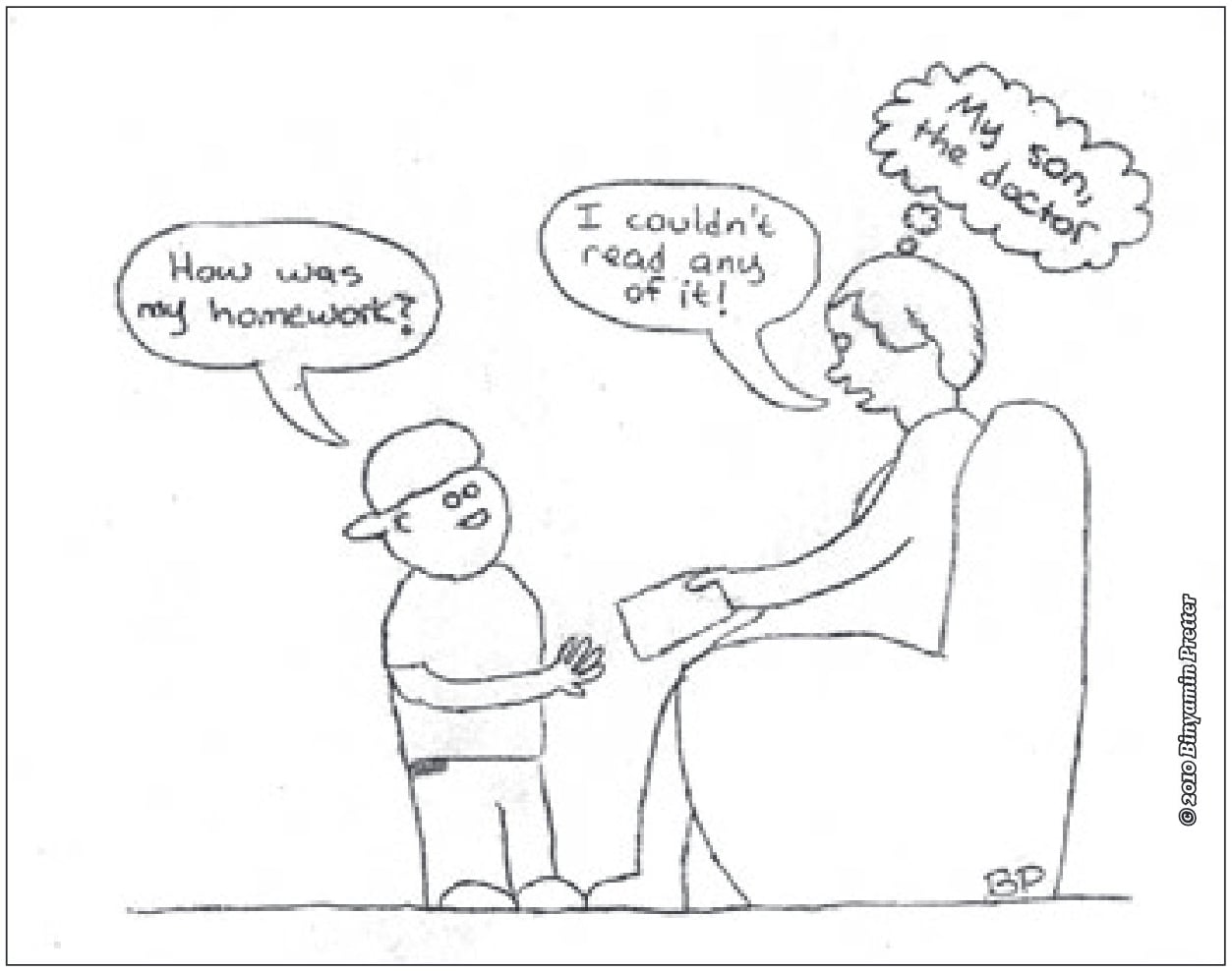
Doctors are notorious for having messy handwriting. Could it be that the same gene that propels doctors to choose their career choice also causes them to have poor penmanship? It seems the solution is a lot more mundane. I asked a doctor who attends my daf yomi chaburah to explain this phenomenon. He simply said that doctors, who are often pressed for time trying to squeeze all their patients in, write quickly and sloppily to save a few moments. Can we find a Talmudic source for cutting down on the neatness of handwriting to save a few moments?
The Gemara (Bava Basra 164b) relates that Rebbe was examining a sh’tar mekushar—a “bound” legal document. This particular type of document is difficult to draft properly. It was instituted for use by kohanim to ensure that they could not divorce their wives quickly in the heat of an argument. A kohen is not permitted to remarry his divorced wife, so this situation was of particular concern to the Sages.
The top of a sh’tar mekushar looks like a Chinese fan with the folds sewn together. Rebbe was inspecting one such document and failed to find the date. His son Rebbe Shimon said that perhaps the date was on the crease of the fold and would become visible when the knots were loosened. The date was indeed there. Rebbe then looked at his son disapprovingly. Apparently he was upset that his son had written the document in such a manner, not being careful that the date should be plainly visible. Whereupon Rebbe Shimon exclaimed, “I didn’t write it; R’ Yehudah Chayata wrote it.” Rebbe retorted, “Desist from this lashon ha’ra.” (Rebbe Shimon could have deflected blame from himself without identifying exactly who wrote the document.)
The Gemara relates that another time Rebbe Shimon was sitting in front of his father, Rebbe, while he was reading Tehillim. Rebbe commented, “How neat is the writing in this Tehillim!” Rebbe Shimon replied, “I did not write it. R’ Yehudah Chayata did.” Whereupon Rebbe responded, “Desist from this lashon ha’ra!” Seemingly, in this instance, Rebbe Shimon was just directing the praise to the proper person. What lashon ha’ra was there? The Gemara explains with a Beraisa quoted by Rav Dimi that states, “A person should not speak about the good qualities of his friend.” The lashon ha’ra was that Rebbe Shimon praised R’ Yehudah Chayata by identifying him as the scribe who wrote the Tehillim.
However, all the commentators are perplexed by the simple reading of the Beraisa. We find many instances in the Talmud where scholars praised one another. How can we understand this Gemara, which ostensibly states that one should never praise his friend?
The Rashbam explains that the Gemara is referring only to excessive praise. When one starts extolling the virtues of an individual, there is likely to be a listener who will counter, “Yes, he’s great in many ways, but . . .” Alternatively, the speaker himself might feel the need to temper his words, such as by saying, “He’s so great, he has only one flaw, which is . . .” Since excessive praise can lead to lashon ha’ra, the Sages forbade it.
The Maharsha questions how the Rashbam’s understanding can be reconciled with our Gemara. Rebbe Shimon was just praising R’ Yehudah Chayata in one area, identifying him as the scribe with the neat handwriting. The Seder Mishnah (authored by the son of the Machatzis HaShekel) explains that excessive praise even in only one trait is forbidden as well. Rebbe didn’t simply say that the person who wrote the Tehillim had neat handwriting. He said, “Kamah—how neat—is this handwriting,” indicating that the handwriting was exceptionally beautiful. Thus, it was forbidden for Rebbe Shimon to identify the person to whom this lavish praise should be directed.
The Maharsha offers an alternative explanation to the Gemara’s explanation. Originally, Rebbe showed displeasure at the scribe who composed the sh’tar mekushar. Rebbe Shimon said that R’ Yehudah Chayata wrote it. Since this was lashon ha’ra, presumably Rebbe did not accept and believe it. In Rebbe’s mind, the identity of the scribe was still in doubt. Rebbe Shimon should have realized that when he identified the scribe who wrote the Tehillim, he was also identifying the scribe who wrote the faulty sh’tar mekushar. This is because Rebbe would recognize the handwriting and realize that the Tehillim and the sh’tar mekushar were written by the same person.
So, in effect, Rebbe Shimon was guilty of saying the same piece of lashon ha’ra twice, namely that R’ Yehudah Chayata wrote the sh’tar mekushar. According to the Maharsha this in fact is the intent of the Beraisa. We see from this story that one must be careful when praising an individual, so that the praise does not indirectly imply something negative as well.
However, one of my talmidim preferred a p’shat offered by Iyun Yaakov (and presumably doctors will as well). He agrees with the Maharsha’s understanding that only praise that also includes derogatory information is forbidden. But he differs as to what the derogatory information in our Gemara was. He says that although we find a mitzvah that a sefer Torah should be written exceedingly beautifully, no such mitzvah exists for a sefer Tehillim. Of course, the Tehillim should have been written neatly. However, it needn’t have been written with an exceptional script that had to be painstakingly completed.
For a talmid chacham as great as R’ Yehudah Chayata, this was considered bitul Torah. (And maybe we should also assume that the nicer script did not make the Tehillim fetch a higher price.) The extra time it took to write such a beautiful script could have been better spent delving into the secrets of the Torah. This criticism was latent in Rebbe’s words, “What a beautiful script this is.” Therefore, Rebbe Shimon should not have identified the scribe who was simultaneously praised and criticized. My talmid feels that one day we will be able to say about him that he did not waste any time writing neatly—his time and energy were conserved for Torah! (However, in the meantime, his teachers had to spend an inordinate amount of time deciphering his words.)
Stories in this article (1)
Stories in this article
More about Rabbi Yehudah HaNasi
All storiesRabbi Chanina and Rabbi Chiya Debate
Rabbi Chiya and His Sons Almost Bring Moshiach
Yosef HaBavli's Face Lights Up with Joy
Rabbi Chama bar Bisa Asks Rabbi Yishmael a Question
More stories in Bava Basra
All in this masechtaYosef Sees an Upside-Down World
Hashem Rebukes Hoshea HaNavi
Rabban Yochanan ben Zakkai’s Nephews and the Lost Dinarim
Luleyanus and Pappas Save the Jews of Lod
Questions on this article
Rabbi Avrohom Sebrow
Rebbe at Yeshiva Ateres Shimon in Far Rockaway. He leads the Daf Yomi chaburah at Eitz Chayim of Dogwood Park in West Hempstead, and writes “Delving into the Daf” each week for The Jewish Home.
About and contact