Heavy Metal
Daf yomi learners finished Masechta Middos this week. Middos discusses the measurements of the Beis HaMikdash and its utensils. Seemingly there is little relevance to us nowadays in knowing these historical facts. Yet the commentators say that learning this masechta carries some added dimensions. According to the Rambam, we will have to build the Beis HaMikdash when Mashiach comes. If we want to build it without delay, there must be people knowledgeable in this masechta to direct the building. (Although if the third Beis HaMikdash will descend from Heaven, we won’t have to worry about the measurement of the walls.)
The Chazon Nachum writes that just learning about the Beis HaMikdash is akin to building it. We find a similar concept that learning about sacrifices is akin to bringing one. We hope and pray that the Beis HaMikdash will be built speedily in our days. But until that time comes, learning about the Beis HaMikdash will have to suffice.
There is a prohibition against constructing any building or fashioning any utensil comparable to the ones used in the Beis HaMikdash. The Meiri writes that we must know the various measurements of the Beis HaMikdash and the keilim in order that we know what not to construct.
Finally, the Beis David notes that even if the details of this masechta are not directly relevant to halachah, they have bearing to other places in Shas. Often a proper understanding of the Beis HaMikdash’s dimensions will elucidate a passage of Talmud that hinges on these historical facts.
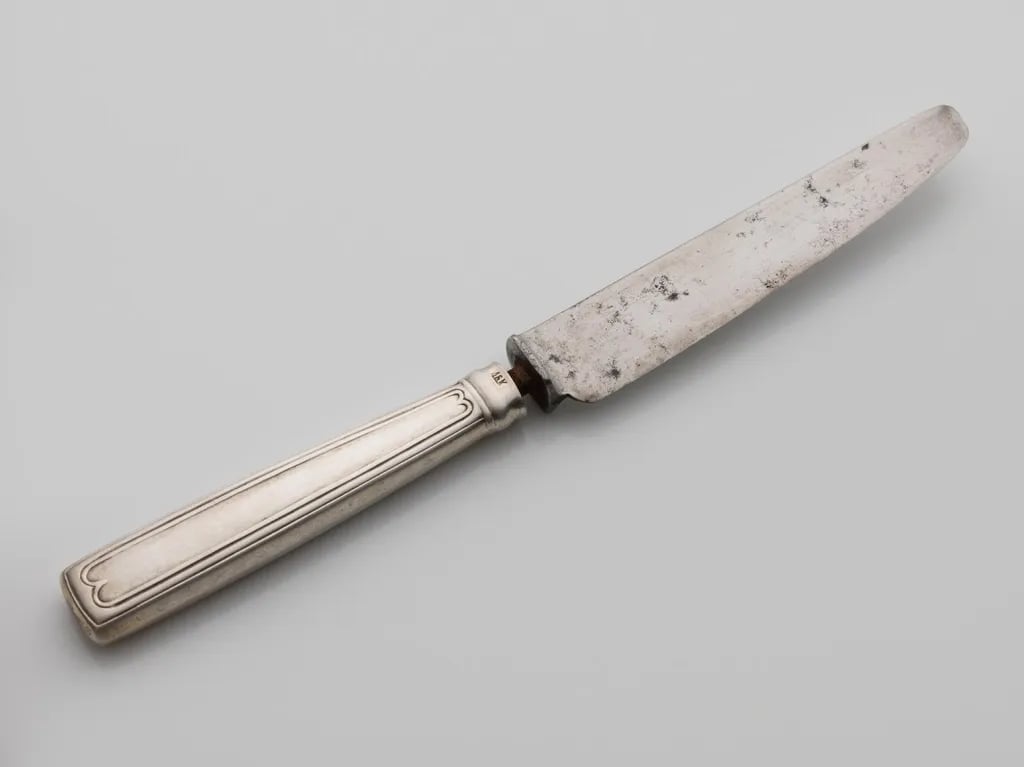
Notwithstanding the above, there are some direct halachic implications from the mishnayos of Middos. One interesting example concerns a custom to remove knives from the table while bentching. The mishnah in Middos rules that if an iron implement even touches a stone of the Altar, that stone is disqualified. Although this law is based on a verse in the Torah, the mishnah offers a reason: One important usage of iron was to construct swords and weapons. These tools of war are designed to shorten human life. It is inappropriate that iron implements should touch the stones of the Altar, which is intended to lengthen human life. When a person offers a sacrifice, he is achieving atonement. The atonement will result in the lengthening of his life.
In halachah we often compare the table we eat on to the Mizbeiach. The Avudraham therefore writes that it is inappropriate at the time that Birkas HaMazon is being recited at the table to have knives present. Similar to the above, knives can be used to shorten human life. The comparison to the Mizbeiach only extends specifically to knives, which in themselves can be used as weapons. However, other metal utensils are fine. According to the Magen Avraham the comparison is further limited to knives made of iron or steel; other metals, such as silver, would be fine. Silver was allowed to touch the Altar, and in fact silver utensils touched the Altar every day.
The Shibolei HaLeket offers a totally different rationale behind the custom of removing knives from the table during bentching. It once occurred that a pious individual was reciting bentching. He reached the berachah of “Boneh Yerushalayim.” He was overcome with grief and pain when he recalled the destruction of the Beis HaMikdash and stabbed himself. To prevent a repeat of such an occurrence, we remove all knives during bentching.
There is a discussion among the Acharonim if it is necessary to actually remove the knives from the table or if merely covering them suffices. It was reported that the Steipler Gaon did not remove the knives from the table, but merely covered the blade and left the handle exposed. The Kaf HaChayim writes that al pi Kabbalah one should totally remove knives from the table during bentching.
The Mishnah Berurah writes that it is not necessary to remove knives from the table on Shabbos. The Aruch HaShulchan writes that grieving is forbidden on Shabbos; therefore, we do not need to worry that someone will be overcome with grief on Shabbos. It is unclear why, according to the Avudraham’s reasoning, Shabbos should be different from the weekday. Even on Shabbos, it was not permitted for one to touch the Altar with an iron implement. Someone suggested that it has to do with the fact that the rebuilding of the Beis HaMikdash will not take place on Shabbos. I’m not sure why that has any relevance. The Aruch HaShulchan offers a different explanation as to why according to the Avudraham we can keep knives on the table during bentching on Shabbos. However, it is beyond the scope of this article. (That is a nice way of saying I really don’t understand it!)
Rav Moshe Feinstein, zt’l, said that one does not have to cover a butter knife, as it is not really considered a knife for the purposes of this custom. Also, many have said that there is no need to cover plastic knives. The Magen Avraham limited the custom strictly to iron knives. Even those that disagree would only include other types of metal. Weapons are not made out of plastic, and one is unlikely to stab himself with a plastic knife.
The Aruch HaShulchan wrote that in his locale this custom was no longer followed.
I would like to note that daf yomi began the last masechta in Shas, Maseches Nidah, this week. If you want to join daf yomi, it’s not too late to get in on the last masechta.
More Gemara stories
More stories in Niddah
All in this masechtaRabbi Chama bar Bisa Asks Rabbi Yishmael a Question
Questions on this article

Rabbi Avrohom Sebrow
Rebbe at Yeshiva Ateres Shimon in Far Rockaway. He leads the Daf Yomi chaburah at Eitz Chayim of Dogwood Park in West Hempstead, and writes “Delving into the Daf” each week for The Jewish Home.
About and contact