Rosh Hashana in a Cemetery
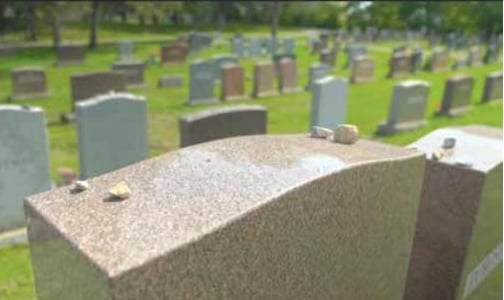
The Gemara in Brachos (18b) records a particularly interesting incident.
A pious man gave a poor man a dinar on Erev Rosh Hashana during years of famine. The pious man’s wife was incensed at his extravagant expenditure during the difficult times. In order to escape the incessant bickering, he went and slept that night (on Rosh Hashana!) in the cemetery. That night, he heard two spirits conversing with each other. One said to the other: “My friend, let us roam the world and hear from behind the Heavenly Curtain [pargod], which separates the Divine Presence from the world, what calamity will befall the world.” The other spirit said to her: “I cannot go with you, as I am buried in a mat of reeds, but you go, and tell me what you hear.” She went, and roamed, and came back. The other spirit said: “My friend, what did you hear from behind the heavenly curtain?” She replied: “I heard that anyone who sows during the first rainy season of this year, hail will fall and strike his crops.”
That year, the pious man went and sowed his seeds during the second rainy season. Ultimately, the crops of the entire world were stricken by hail, and his crops were not stricken.
The commentators note that, as a rule, when the Gemara refers to a pious man without identifying who it is, it refers to either Rebbe Yehuda ben Bava or Rebbe Yehuda the son of Rebbe Ilai. (The latter was made “famous” by a recent popular song.) The commentators are perplexed as to why either of these great sages would sleep on Rosh Hashana night in a cemetery. Why couldn’t he stay by a friend’s house?
The Iyun Yaakov suggests perhaps it was precisely because it was Rosh Hashana. We do so many things as good omens on Rosh Hashana, getting angry would be the exact opposite. Nevertheless, he did not want to sleep at a friend’s house. One can imagine if the Gadol HaDor would ask to sleep by your house, you would immediately wonder why. If someone guessed there was an argument, no one would blame the Gadol HaDor. Likewise here, Rebbe Yehuda was forced to leave the house to get some sleep, but he didn’t want anyone to cast aspersions at his wife. He decided to spend an uncomfortable Rosh Hashana night in the cemetery, where no one would find him, to save his wife from embarrassment. Hashem rewarded him, and he was blessed that year with bountiful crops.
This incident is cited by the commentators at least twice in Rosh Hashana. Most recently, it was cited by Tosfos on 16a. The Mishna says that there are four times the world is judged: On Pesach for produce, on Shavuos for fruit, on Sukkos for water, and on Rosh Hashana all the inhabitants of the world are judged.
Tosfos cites the aforementioned story in Brachos which seems to indicate that on Rosh Hashana the world is judged on crops. After all, Rebbe Yehuda heard one spirit saying to another that she heard from behind the Heavenly Curtain the decree about crops. Moreover, the Tosfos HaRosh notes that we say in Mussaf on Rosh Hashana, “And on the countries, it will be said, which is to war, which is to peace, which to famine, and which to plentifulness, and the fate of creatures will be decided to life and to death.” This seems to also indicate that the fate of crops is decided on Rosh Hashana. The Ritva resolves these questions by declaring that the halacha does not follow the Mishna. In fact, all matters, even decisions regarding crops, are decreed on Rosh Hashana. However, Tosfos differs and reasons that the story and the text of Mussaf can be explained even according to the Mishna. Those sources do not actually say that the decrees regarding crops took place on Rosh Hashana. The running of the world is a giant puzzle. As part of Hashem’s decrees regarding individuals, the decrees regarding crops and countries are mentioned on Rosh Hashana. Indeed, the Turei Even asked how it is possible for a person to be judged on Rosh Hashana and crops to be judged on Pesach. Isn’t a person’s situation dependent on the food supply and inextricably linked? The Turei Even explains that a person is judged on Rosh Hashana according to the framework that was already decided about the world’s food supply. There will be a finite amount of crops, but how much of those crops each person is entitled to is decided on Rosh Hashana. Therefore, in Mussaf we say, “It will be said…. Which to famine,” not “it will be decided which to famine.” The previous decrees will be cited on Rosh Hashana so that a person’s individual’s fate can be decided now.
Tosfos’s explanation also clarifies another anomaly. The Gemara states (8b) that Hashem does not judge His people until Beis Din declares the day to be Rosh Hashana. Beis Din convenes only during the daytime. How could it be that Rebbe Yehuda heard the decrees regarding the crops on Rosh Hashana night? The decrees are only promulgated by the Heavenly Court on the day of Rosh Hashana. (This question was asked by the Gilyonei HaShas.) According to Tosfos, the answer is simple. There weren’t any new decrees made on that Rosh Hashana yet. However, the decrees made previously on Pesach regarding the crops were mentioned on the night of Rosh Hashana.
If a person, Heaven forbid, was issued a bad decree on Rosh Hashana/Yom Kippur, can it be changed? Tosfos (16a) opine that public prayers are effective even after a bad decree is issued. Moreover, a prayer that includes the public is considered a public prayer. Hence, when davening for sick people, r”l, we always plead that the sick person should be cured “together will all the sick people of K’lal Yisrael.” The Gemara concludes that according to Rebbe Yitzchak, any prayer can be effective to annul a bad decree. (Ritva 17b)
It is worthwhile to mention that the above explanations notwithstanding, many commentators opine that the story that took place with Rebbe Yehuda was actually a dream. The Noda B’Yehuda explains that Rebbe Yehuda’s mind was always focused on spiritual matters. However, due to the fight with his wife, his mind was preoccupied with matters about his livelihood. He dreamt about the spirits in the cemetery. Ultimately, he was rewarded for his charity by having the secrets of the world revealed to him.
Stories in this article (1)
Questions on this article
Rabbi Avrohom Sebrow
Rebbe at Yeshiva Ateres Shimon in Far Rockaway. He leads the Daf Yomi chaburah at Eitz Chayim of Dogwood Park in West Hempstead, and writes “Delving into the Daf” each week for The Jewish Home.
About and contact