The Sukkah, the Gallows and the Menorah
From the comments I received about my previous article (September 1), I realized several things. Firstly, many people read the Five Towns Jewish Times. Secondly, from the number of women who commented on my “Insights On the Daf” article, I realized that many women do the daf. Thirdly, from the fact that the managers at Brach’s did not comment on my article, I must conclude that Yolanada and Andy Tutone do not do the daf.
One person told me how much he really enjoyed my article. So I tried to discuss with him the finer points of Rashi. He said “Oh, I stopped reading after the story.” So this week the story will come last!
What do Chanukah and Purim have to do with Daf Yomi Sukkah? (Answer to follow)
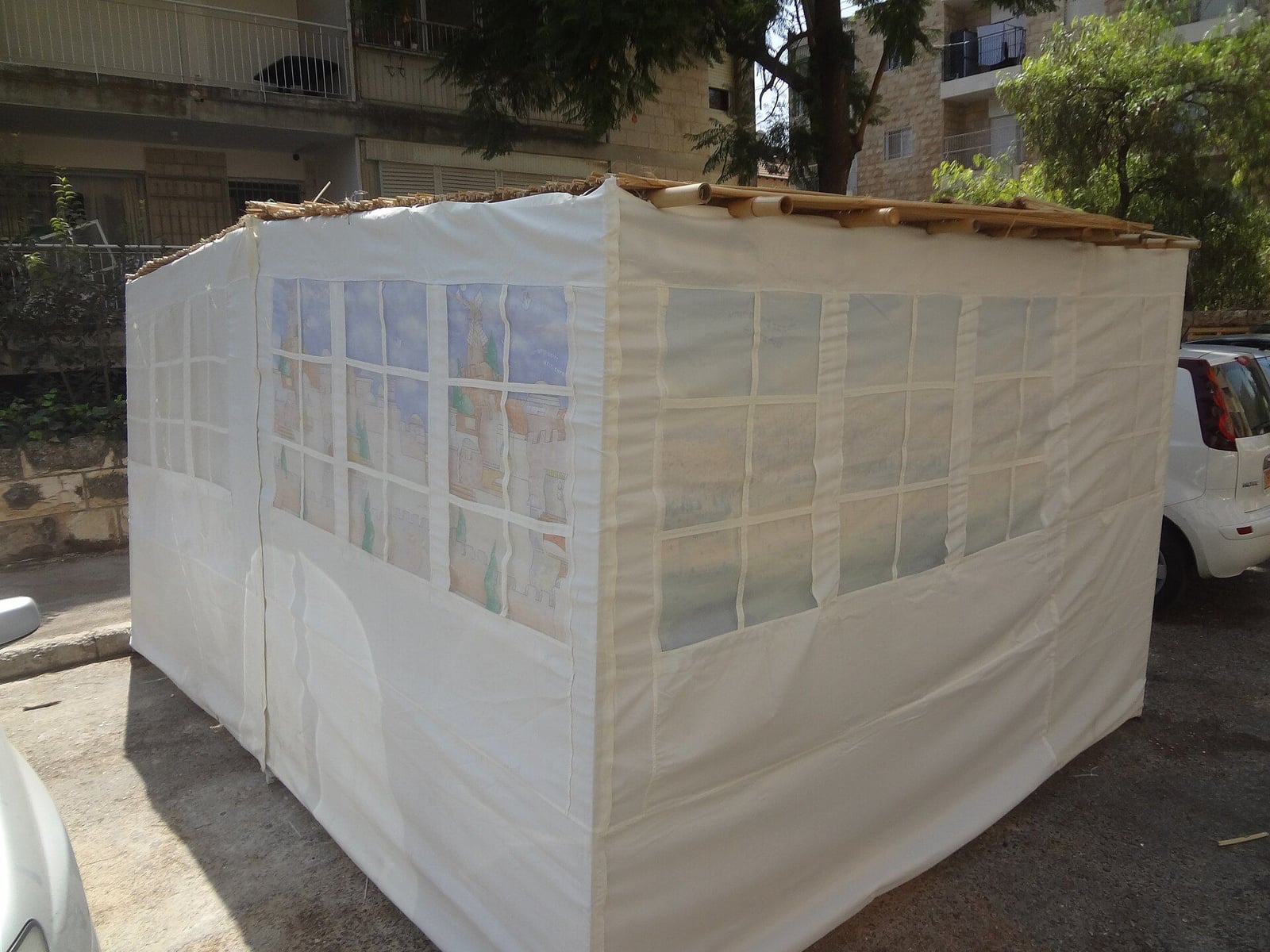
Maseches Sukkah begins with the halachah that a sukkah that is taller than 20 amos (between 30 and 40 feet) is invalid. Rabbah explains that there is a halachic requirement that one be cognizant of the fact that he is sitting in a sukkah. To facilitate this, the s’chach, which is the primary part of the sukkah, should be readily visible. A person’s eye can wander up to 20 amos; if an object is higher than that, a person must make a conscious decision to view it. Since we want a person to be continuously aware of the s’chach, it has to be at a height where he will see it without too much thought (Rivan).
The Megillah says that Haman made a gallows to hang Mordechai, 50 amos tall. Wouldn’t it have been better to make the gallows shorter so that people could see it without conscious thought? The obvious answer is that Haman didn’t do the daf. But when Haman was finally hanged, why were the gallows left at that height? (Presumably the righteous people of Shushan did the daf!)
The Gemara (Sukkah 2b) clarifies that, according to Rabbah, if the sukkah walls reach all the way up to the s’chach, then the sukkah is indeed valid even if the s’chach is higher than 20 amos. (According to Rabbah, an example of an invalid sukkah would be where the s’chach is attached to a nearby structure over 20 amos, but the walls of the sukkah are only 15 amos high.) The Gemara explains that the walls would naturally guide one’s vision to follow them up to the s’chach (even higher than 20 amos), and one would thereby be cognizant of the fact that he is sitting in a sukkah. (This is a common technique in art: to use pictorial elements to guide the viewer’s eye.)
The Imrei Emes (Gerrer Rebbe) explains that this is true about the gallows, as well. People would see the bottom of the gallows and naturally follow the wood to the top.
Many commentators raise the following question: The halachah is that one may not place his Chanukah menorah higher than 20 amos above the floor. The rationale is that the menorah should be readily visible to publicize to miracle of Chanukah. As explained earlier, one does not gaze higher than 20 amos without conscious effort. Why don’t we say that if the menorah is placed on a shelf on a wall, a viewer’s eye would follow the wall until the menorah, the tall height not withstanding? There are several answers given. The Turei Zahav (O.C. 671:5) answers that when it is dark, one’s eye won’t necessarily follow the wall, because the wall itself is hard to see. The mitzvah of menorah is only at night; due to the lack of light, one’s eye may not follow the wall up until the menorah. The sukkah, however, is used both during the day and at night, so (according to Rabbah) it suffices that during the day one’s eye will be able to follow the wall up to the s’chach.
The halachah is not like Rabbah; the s’chach must always be below 20 amos. However, the halachah is that the walls do not need to reach the s’chach, as long as they have a minimum height of 10 tefachim (30 to 40 inches) and they are directly under the s’chach.
At a conference I attended in 2004 about issues relating to kiruv, I heard the following story:
A rabbi and his chaverim went to a city in England to revitalize the state of Yiddishkeit there. They constantly encountered opposition to the changes they wanted to make to keep the community in line with halachah. One oft-repeated phrase was “Rav Unterman didn’t do it, and if it was good enough for Rav Unterman, it’s good enough for me.” (Rav Unterman was the Chief Rabbi of Liverpool until 1946.) Rav Unterman hadn’t been there for many years, and there was no way of ascertaining what Rav Unterman really had or hadn’t done.
After Yom Kippur, they asked the 75-year-old gabbai if the shul had a sukkah. He replied “Sure!” The night before Sukkos, they asked him to show them the sukkah. He took them to a room in the shul, pulled a lever, and some boards in the center of the ceiling opened up to reveal the sky. “Just put some s’chach up!” he said. They realized right away that it was invalid; the walls of the room were too far away from the opening in the center of the room to be kosher sukkah walls. After the gabbai left, the rabbi had an idea: They stacked chairs up in the center of the room and tied the bottoms with twine. (The twine was necessary to form halachic walls around the legs of the bottom chair.)
They thereby formed four walls out of chairs. They were nervous about the gabbai’s reaction to their creation. Sure enough, in the morning the gabbai screamed. “What did you do? The place looks horrendous. Rav Unterman didn’t do this. And if it was good enough for Rav Unterman, it is good enough for me.” Just then, the 70-year-old non-Jewish caretaker walked in. He exclaimed “Wow! The chairs, the rope, the mechitzah—I haven’t seen them since Rabbi Unterman was here!”
More Gemara stories
Questions on this article

Rabbi Avrohom Sebrow
Rebbe at Yeshiva Ateres Shimon in Far Rockaway. He leads the Daf Yomi chaburah at Eitz Chayim of Dogwood Park in West Hempstead, and writes “Delving into the Daf” each week for The Jewish Home.
About and contact