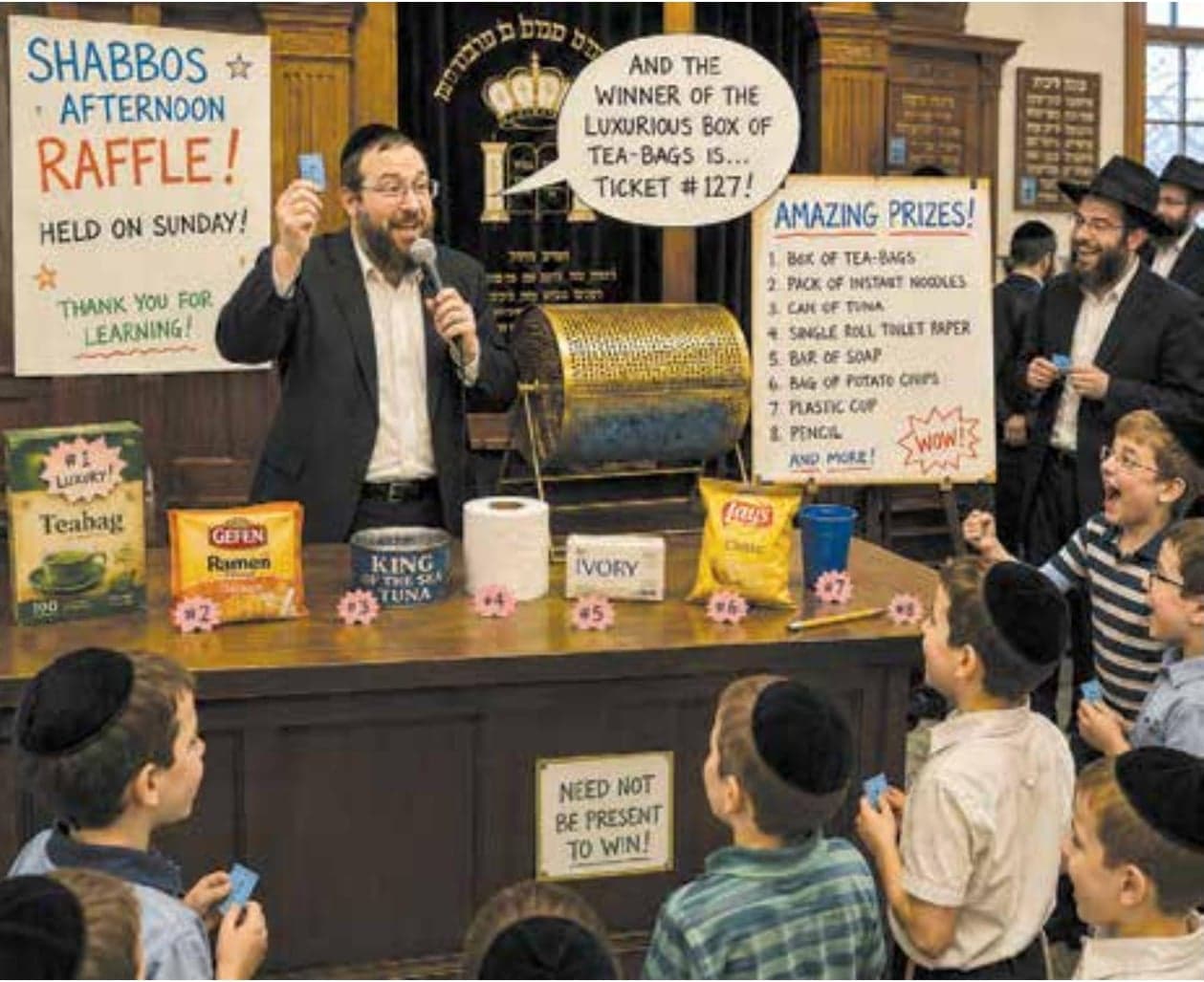
It is 5:45 PM on a sticky July Shabbos afternoon in the Catskills. Inside the wood-paneled walls of the main shul, a single window AC unit is fighting a valiant, entirely losing battle against the ninety-degree heat.
For the past forty-five minutes, fathers and sons have been engaged in the sacred tradition of the Shabbos afternoon learning program. Or rather, the fathers have been desperately trying to shake off their heavy, cholent-induced Shabbos shluf, while their sons vibrate at a frequency high enough to shatter glass.
But learning time is over now. The Gemaras are closing. The tension in the room is palpable. It is time for the main event.
It is time for The Raffle.
A Treasure Trove of Upstate Dreams
To the untrained eye, the folding table at the front of the shul holds a random assortment of clearance toys. But to an eight-year-old boy in a bungalow colony, this is the ultimate showcase showdown.
The loot this week includes:
• The Shabbos Menace: A Nerf gun with exactly six foam darts. By Shalosh Seudos, three darts will be stuck on the shul roof, two lost in the tall weeds, and one shot directly into a sibling’s ear.
• The Static Broadcasters: A pair of battery-devouring walkie-talkies with a range of exactly twelve feet. They cannot actually connect to each other, but they will occasionally pick up the local Hatzalah radio frequency. (Since it is muktzeh, a picture of the prize suffices for today.)
• The Roof Magnets: A standard football and a neon frisbee. Both are destined to be thrown onto the roof of a bungalow before Sunday morning, never to be retrieved.
• The Decoy Prize: Yet another travel game of chess. It is the fourth one circulating the colony this summer, and half the pawns are strewn on the fields.
But is this raffle actually permissible on Shabbos?
The Halachic Ground Rules
The Shulchan Aruch (Orach Chaim 322:6) lays down the basic ground rules: casting lots on Shabbos is generally forbidden. It bears too much resemblance to weekday commerce, dividing partnerships, or gambling, and it may lead to forbidden writing or measuring.
There is one notable exception: you are allowed to cast lots within your own household, among your own children, to decide who gets which portion of food. The logic is simple; family members are not going to drag each other to a Din Torah over an extra scoop of cholent. Because no one is strictly particular about the exact monetary value of the outcome, it doesn’t cross the line into prohibited commerce.
The Mitzvah Exception
But what about the shul raffle? The Magen Avraham (O.C. 322:9) issues a fascinating ruling. He states that while you cannot cast lots to divide physical items, you are allowed to cast lots on Shabbos to determine who gets to perform a mitzvah such as who will get an aliyah or who will lead the davening as a chiyuv.
Where does the Magen Avraham find the precedent for this? He looks straight to the Beis Hamikdash.
He points out that they used to cast lots in the Beis Hamikdash on Yom Kippur to determine which Kohen would slaughter the korbanos and who would throw the blood. Since Yom Kippur carries all the stringent halachos of Shabbos, we see clearly that running a lottery for a mitzvah is perfectly permissible.
The Daf Yomi Dilemma
Here is where anyone learning our daf in Maseches Yoma will immediately raise an eyebrow, just as the Shvus Yaakov (Vol. 1, Siman 40) does.
Our sugya makes it abundantly clear: The Kohen Gadol performed all of the avodah on Yom Kippur! He was a one-man show.
The Shvus Yaakov points out this glaring contradiction: If the Kohen Gadol did everything himself on Yom Kippur, there was absolutely no need for a lottery to divvy up the tasks among the other Kohanim!
Resolving the Conflict
The Kesef Mishneh steps in to clarify. While it is absolutely true that the Kohen Gadol had exclusivity, this only applied to the specific Yom Kippur day services. However, the regular daily services, which were really tied to the previous day’s avodah, like Terumas Hadeshen (removing the ashes) or cleaning the inner altar still needed to get done.
According to the Kesef Mishneh, who cites the liturgy instituted by the Geonim, there actually was a payis (lottery) on Yom Kippur for these standard, everyday avodos. The regular Kohanim still had a chance to participate in these services, and they used a lottery to decide who won the privilege.
Therefore, the Magen Avraham’s proof remains airtight. A lottery was indeed held on Yom Kippur, proving that drawing lots for a mitzvah does not violate the sanctity of Shabbos.
The Modern Shabbos Raffle: Piskei Halacha
Despite this, the Magen Avraham’s heter was limited to the right to perform services (like saying kaddish or getting maftir). It wasn’t intended for physical objects. Furthermore, some suggest that the Magen Avraham’s permit does not allow for the use of physical tickets. (While this limitation is often based on the Shvus Yaakov, a careful reading indicates he may not have actually made such a strict limitation.)
So, where does that leave our bungalow colony?
• Rav Yitzchak Berkowitz was asked: “It seems not uncommon to have raffles for kids during Shabbos learning programs. From the Shulchan Aruch, it looks problematic. Is there a valid heter for this practice?” His straightforward response: “I am not aware of a heter.” Those who follow this ruling should make the raffle on Sunday. It is an interesting question whether tickets may be distributed on Shabbos. Since the raffle cannot be held on Shabbos, the tickets may be muktzeh.
• Rabbi Rosenberg (grandson of Rav Shmuel Wosner) of Kollel Zichron Chaim in Bobov takes a more lenient approach. He says that for a mitzvah whose time is that day, a raffle is permitted. Still, he points out that giving the prize to a child on Shabbos, even without a raffle, can be problematic regarding the laws of acquisition (kinyan). He advises stipulating that the child should not formally acquire the prize until after Shabbos.
The “DAF” Solution
Another possible avenue for a heter might be based on a different kind of DAF. Not the Gemara, but Donor Advised Funds.
In the secular financial world, donations made to a Donor Advised Fund are tax-deductible because, legally, the donor surrenders control over how the funds are spent. The donor can advise the fund on where the money should go, and while the fund doesn’t legally have to accept the recommendation, in practice, they virtually always do.
The Shabbos raffle can be held using the exact same logic. The boys have no true monetary claim to the prizes. Although they learned beautifully, they cannot legally demand a prize. The organizers of the learning program are simply handing out prizes randomly to make learning exciting, and they decided that a raffle is a fair way to choose the recipients.
Because the organizers made the rules, they retain the power to break them. To utilize this heter, the organizers can make the following announcement (verbally or via a sign):
“This raffle is strictly advisory only, and the organizers are the ultimate arbiters of who actually gets the prize.”
What this actually means for the kids: If your number gets picked, we are 99.9% going to give you the Nerf gun provided you haven’t fought with your siblings in the last ten minutes.
Maggid shiur and Rebbe at Yeshiva Ateres Shimon in Far Rockaway. He leads the Daf Yomi chaburah at Eitz Chayim of Dogwood Park in West Hempstead, and writes “Delving into the Daf” each week for The Jewish Home.