Bite Your Tongue
Attending a yom tov seudah and spotting an inviting platter of beef tongue on the table is the ultimate test of fortitude. Your mind immediately starts wondering if taking a slice means entering into a mutual tasting…
Beis HaMikdash and Korbanos
The kohanim, the Kohen Gadol and Birkas Kohanim.
Attending a yom tov seudah and spotting an inviting platter of beef tongue on the table is the ultimate test of fortitude. Your mind immediately starts wondering if taking a slice means entering into a mutual tasting…
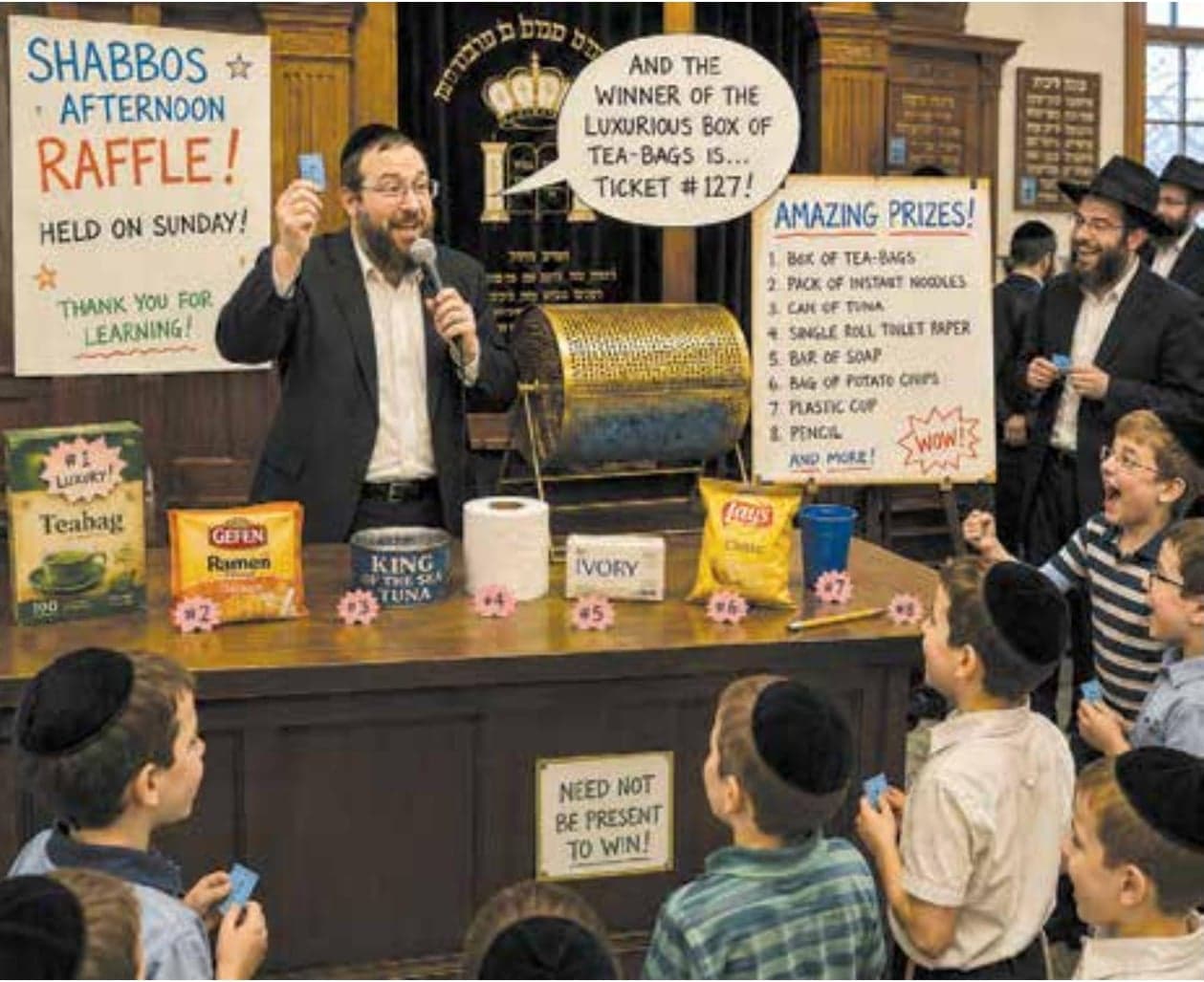
It is 5:45 PM on a sticky July Shabbos afternoon in the Catskills. Inside the wood-paneled walls of the main shul, a single window AC unit is fighting a valiant, entirely losing battle against the ninety-degree heat.
Which of our forefathers were considered bechoros? Was Avraham Avinu a bechor? What about Yitzchak or Yaakov? The Mishnah in Zevachim (14:4) teaches that before the Mishkan was built, the avodah was performed by…
The Gemara (Zevachim 100a; see also Moed Katan 23a) and its commentators discuss various details of the following account, and some aspects are subject to interpretation.
It seems that sitting in the left lane, engine idling while waiting for oncoming traffic to clear so you can make a left-hand turn is wasteful—not only of time and peace of mind but also of gas and therefore money.
With many people traveling for Sukkos and the winter season, it’s appropriate to review some of the halachos of davening on a plane. Those learning the Daf may not realize how this discussion stems directly from our…
What is the mysterious creature known as a Rechesh? At first glance, one might wonder how this relates to Bava Basra. However, Rav uses this enigmatic creature to clarify his position (152b).
In 1961, Edward Lorenz used a numerical computer model to rerun a weather prediction. As a shortcut on a number in the sequence, he entered the decimal .506 instead of the full .506127 the computer would hold.
Often, the Gemara faces a halachic question that it can’t resolve. In that situation, the Gemara declares, “Tayku!” The simplest explanation of that word is that the question should stand.
There is an oft repeated story involving Rav Moshe Feinstein, zt”l. Rav Moshe was attending a bris. There were two cartons of chalav Yisrael milk in front of him, from two competing brands with different hechsherim.
There are many complex halachos about interrupting one’s prayers for various responses. At some points in davening, it is forbidden to respond, “Boruch Hu u’baruch Shmo.” At other points, one cannot even respond amein.
Rabbi Shragga Kallus delivered an enthralling and engaging lecture filled with Torah riddles. One such riddle was: “What are two scenarios where a person would answer ‘amein’ in the middle of his private Shemoneh…
True events and several recent passages in Nazir inspire the following story. Boruch Cohen and Shimon Levi board a plane together somewhere in the United States.
The great Rishon Rabbeinu Chaim HaKohen once remarked that had he already been born when Rabbeinu Tam passed away, he would have become tamei and gone to his funeral.
The story is told of a man who approached a rabbi. He said to him, “Why are you always so machmir? Every time I ask you a question, the answer is always that it is forbidden.” The rabbi said, “I’m surprised to hear you…
A visitor to the Munkacser beis midrash might see a bizarre sight. He might notice his friend Mr. Katz davening Shacharis there on Monday morning.
The Torah awarded kohanim with terumah gifts. After terumah was separated from freshly grown Israeli produce, the farmer would separate 10% of what remained and give that to a Levi. This is termed Ma’aser Rishon.
The Gemara in Succah (5a) is attempting to find a source that the minimum height of a succah is ten tefachim (30-40 inches). Tosfos opines that the same source will apply to walls that enclose a domain for the purposes…
Twenty-five years ago, there was an established shul that let it be known that they were looking for a new rav. There were many candidates for the one position.
The Medrash Tanchuma (Parshas Tazria 6) cites a story about an impoverished kohen living in Eretz Yisrael. Trying whatever he could to support his family, he just couldn’t make ends meet.
Everyone knows how hard it is to wake up in the morning. One Siyum HaShas video in fact focused on the coffee served at the Daf. Many Daf Yomi shiurim take place early in the morning, and coffee provides a welcome boost.
Rebbi Yose ben Kisma said: Once I was walking by the way when I met a man. He greeted me and said, “Rabbi, where are you from?” I responded, “I am from a great city of sages and scribes.” He said to me, “Rabbi, would…
If you had asked someone 2,000 years ago what “eBay” means, he would have told you “it’s fruit.” Onkelos uses the word “ebay” many times in his translation of Bereishis. Nowadays, eBay is an Internet success story.
Daf Yomi learners finished their brief foray into Talmud Yerushalmi. Mesechta Shekalim of the Jerusalem Talmud was completed this week, and the cycle continued with Mesechta Yoma of Talmud Bavli.
The Mishnah in Shekalim says there were 13 monetary collection containers in the Beis HaMikdash. There is no Talmud Bavli on Shekalim; therefore, at the end of Menachos, the Gemara elaborates on the reason for the many…
One makes a berachah of Shehecheyanu on a mitzvah that comes at a specific time of the year. We recite the berachah of Shehecheyanu on every yom tov.
Our Gemara discusses the laws of avodah in the Beis HaMikdash. Avodah performed by kohanim while sitting is invalid (Zevachim 23b). It is viewed as if a non-kohen performed the avodah.
Many times I have heard this same story involving Rav Moshe Feinstein, zt’l. Rav Moshe was attending a b’ris. There were two cartons of chalav Yisrael milk in front of him, from two competing brands with different…
A year ago, I was asked to keep a group of 40 or so youngsters of varying ages busy on yom tov so that their parents could daven. I elected to tell them a story.
The Gemara relates that there was a question that plagued Rabbah and Rav Yosef for 22 years. Rashi notes that the number 22 was not coincidental. Rabbah served as rosh yeshiva for 22 years before he passed away.
As the cold snap for our area continues, it might hearten us to know that people elsewhere have it worse. In Chicago, the temperature has already been below zero for 20 days this winter season.
The Mordechai (Gittin 461) relates that Rabbeinu Tam once allowed a kohen to pour water over his (Rabbeinu Tam’s) hands. This caused one of his students to inquire as to how he could allow a kohen to serve him, being…
It seems that sitting in the left lane, engine idling, waiting for oncoming traffic to clear so you can make a left-hand turn is wasteful not only of time and peace of mind, but also of gas and therefore money.
The Gemara (Pesachim 87b) offers numerous explanations as to why Hashem chose Bavel as the destination for the exile. One such explanation is that the language spoken in Bavel, Aramaic, was most similar to Hebrew.
I had a friend who purchased an air-line ticket using his frequent-flyer miles. Some issue arose and he needed to contact customer service while at the airport.
One of my daughters loves the Shabbos zemer “Ki eshmerah Shabbos keil yishmereini, os hi l’olmei ad beino u’veini…” It was written by Rav Avrohom Ibn Ezra. For some reason, some bentchers leave out this particular zemer.
Yehonasan sends Dovid off without food, Achimelech feeds him in Nov, and Doeg's slander leads Shaul to wipe out the city of kohanim.
Abaye thinks Rav Huna could divorce and remarry his wife so she can collect her kesubah from his wealthy father, until he learns Rav Huna is a kohen.
Asked whether he is a kohen, Eliyahu HaNavi says he is from Shevet Binyamin, and explains that the first small loaf he asked the widow for hinted at Moshiach ben Yosef.
After the Romans kill Rabbi Akiva, Eliyahu HaNavi buries him. Asked how a kohen may do so, he answers that tzaddikim do not transmit tumah even after death.
Rabbah bar Avuhah meets Eliyahu HaNavi in a non-Jewish cemetery, asks him about collecting a debtor's assets, and asks how a kohen may stand among graves.
A kohen learned his flight home from Israel would pass over a Jewish cemetery. Rav Dovid Feinstein ruled he must spend whatever it took to avoid it, so he bought a new ticket.
The righteous and wise King Uziyahu enters the Heichal to offer the Ketores, reasoning a king may, and is stricken with tzara'as for the rest of his life.
Achimelech feeds the fleeing Dovid, Doeg informs, and Shaul wipes out the city of Nov. Hashem then holds Dovid accountable and offers him a choice of punishments.
Rabbah bar Avuhah finds Eliyahu HaNavi standing in a non-Jewish cemetery and asks how a kohen may be there; Eliyahu cites Rabbi Shimon bar Yochai.
In the Second Beis HaMikdash, the wealthy Marta bas Baitos pays King Yannai a half-se'a of dinars to make her fiancé, Yehoshua ben Gamla, Kohen Gadol.
A poor kohen teaches his wife the laws of tzaraas before leaving to earn a living abroad, and her reply about a single hair convinces him to stay home.
Rabbeinu Tam lets a kohen pour water over his hands. A student challenges him, Rabbeinu Tam stays silent, and Rabbeinu Peter explains why it was allowed.
After he and one bochur were the only kohanim to duchen one Yom Tov, Rav Henoch Leibowitz greeted that talmid for years with a smile and the word 'duet.'