Crockpot Controversies
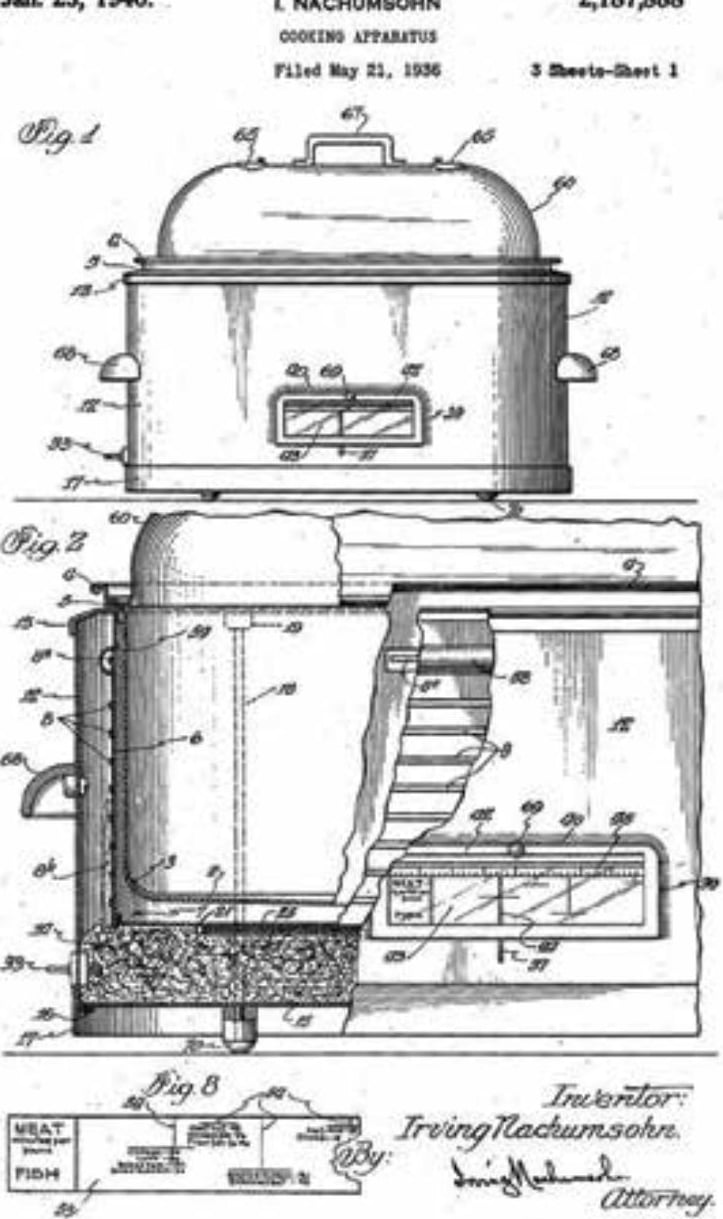
When Irving Nachumson filed for a patent in 1936, could he have imagined that his invention would be the center of a major halachic controversy sixty years later? Did it cross his mind that flintstones from medieval France might be used to defend his invention?
Inspired by cholent, Irving Nachumson invented the slow cooker. Upon purchasing his company in 1970, the Rival company rebranded his device as the “Crockpot.”
While the crockpot certainly makes it easy to have hot cholent on Shabbos, it does have its halachic issues. This article will focus on the great controversy that erupted in 1995. Chazal decreed that on Erev Shabbos, one should not insulate hot food in a material that adds heat. They were concerned that if one were to submerge his food item in a heat-producing medium, the following week he may submerge his food in coals. One may certainly not insulate his food before Shabbos in hot coals, because he may come to stoke the coals on Shabbos. Therefore, Chazal forbade hatmana, insulating food in a heat-producing medium before Shabbos.
The Crockpot became immensely popular. In 1971, the Rival company recorded $2 million in sales of the product. By 1975, sales reached $93 million. Anecdotally, a sixth grade class was asked this year, “How many of your parents use a crockpot for cholent?” Virtually all boys raised their hands. The Rebbe called on one boy who didn’t, and he said his parents used a slow cooker instead!
The problem with the crockpot is that the insert is surrounded by a metal pot outside that produces heat. It would seem that the use of a crockpot violates the laws of hatmana. (This is a separate issue from the laws of shehiya, leaving even uninsulated food on a fire.) Supposedly, the last ruling that Rav Shlomo Zalman Auerbach, zt”l, gave in his life is that crockpots may not be used on Shabbos because of this very issue. This ruling is cited in Minchas Shlomo, Shulchan Shlomo, Meorei Aish, and in the Torah journal Moriah. In 1995, this caused a major controversy. Shabbos observant families had been using crockpots for years. Some switched to a different appliance where the pot rests on a hot plate specifically made for it. This is now commercially sold as the West Bend slow cooker. There is no issue of hatmana with the West Bend because the pot is not covered at all. It simply rests on a heating element. Some advise users of the original crockpot to place a stone on the bottom. This will raise the insert to a point where hatamana won’t be an issue.
It is interesting to note that the author of Meor Shabbos testified that Rav Shlomo Zalman wrote to him that a crockpot is indeed permitted to be used on Shabbos. Therefore the Meor Shabbos subsequently wrote an additional letter to Rav Shlomo Zalman to clarify reports that he changed his opinion. Alas, the letter was on Rav Shlomo Zalman’s table when he slipped into a coma from which he never recovered. The Meor Shabbos insists that Rav Shlomo Zalman’s son confirmed that he was indeed lenient. Nevertheless, it has been accepted that Rav Shlomo Zalman, zt”l, was machmir.
Still, many other poskim were known to have permitted the use of the crockpot. Years before the controversy arose, Rav Moshe Feinstein, zt”l, is reported to have permitted its use. It is cited in V’Debarta Bam that both Rav Moshe, zt”l, and his son Rav Dovid, zt”l, permitted its use.
A major reason to be lenient is that the Rema writes that one may partially submerge food in heat-producing material before Shabbos. The crockpot insert is only surrounded by heat-producing elements on the sides and bottom. It is open on the top. Many poskim cite this Rema as a major reason to be lenient.
Still, Rav Shlomo Zalman said that a crockpot is always open on the top! One cooks that way during the week. How can we be lenient on hatmana if that is the way it is always done? Typically, foods used to be completely insulated if one wanted to keep them warm, but not with a crockpot!
Various answers were suggested to this issue. Rav Pinchas Scheinberg zt”l’s approach may find a source in a Tosfos in Bava Basra (19a). Tosfos suggests that in the times of the Gemara no one would submerge a pot in flintstones to keep it warm. The flintstones would damage the pot. Since it was totally uncommon to insulate hot food in flintstones, Chazal never forbade their use. Rabbeinu Tam comments that our custom is to insulate hot food in flintstones before Shabbos. Rav Moshe, zt”l, is incredulous! The only reason that flintstones were permitted by Chazal is because their use was uncommon. How could Rabbeinu Tam write that it became the custom to insulate in flintstones? If it became common to use flintstones, then their use is forbidden! Rav Moshe, zt”l, concludes that it must be that Chazal gave a list of what items were included in the decree of hatmana. Flintstones were not on that list. If Chazal made the decree in medieval France, then flintstones would have been on that list. However, we do not make our own decrees. If it was permitted in the times of Chazal, it remains permitted.
So, too, Rav Scheinberg suggests the same logic could be applied to the crockpot. Chazal said that an item that is only partially submerged is not subject to the laws of hatmana. Granted, if the decree was made today maybe it would have included the crockpot. However, once the rule was made that a partially submerged item is not subject to the laws of hatmana, it remains that way. Therefore, since a crockpot insert is not covered on top with a heating element, it may be used to insulate the cholent for use on Shabbos.
Rav Shmuel Wosner, zt”l, and Rav Shternbach, shlita, also ruled leniently.
Please note it is advisable to use a blech with a crockpot and to cover the knob for a different halachic reason.
Stories in this article (1)
Stories in this article
More about Rav Shlomo Zalman Auerbach
All storiesRebbetzin Leah Auerbach and the Photochromic Glasses
More stories in Bava Basra
All in this masechtaYosef Sees an Upside-Down World
Hashem Rebukes Hoshea HaNavi
Rabban Yochanan ben Zakkai’s Nephews and the Lost Dinarim
Luleyanus and Pappas Save the Jews of Lod
Questions on this article
Rabbi Avrohom Sebrow
Rebbe at Yeshiva Ateres Shimon in Far Rockaway. He leads the Daf Yomi chaburah at Eitz Chayim of Dogwood Park in West Hempstead, and writes “Delving into the Daf” each week for The Jewish Home.
About and contact