Fair and Square
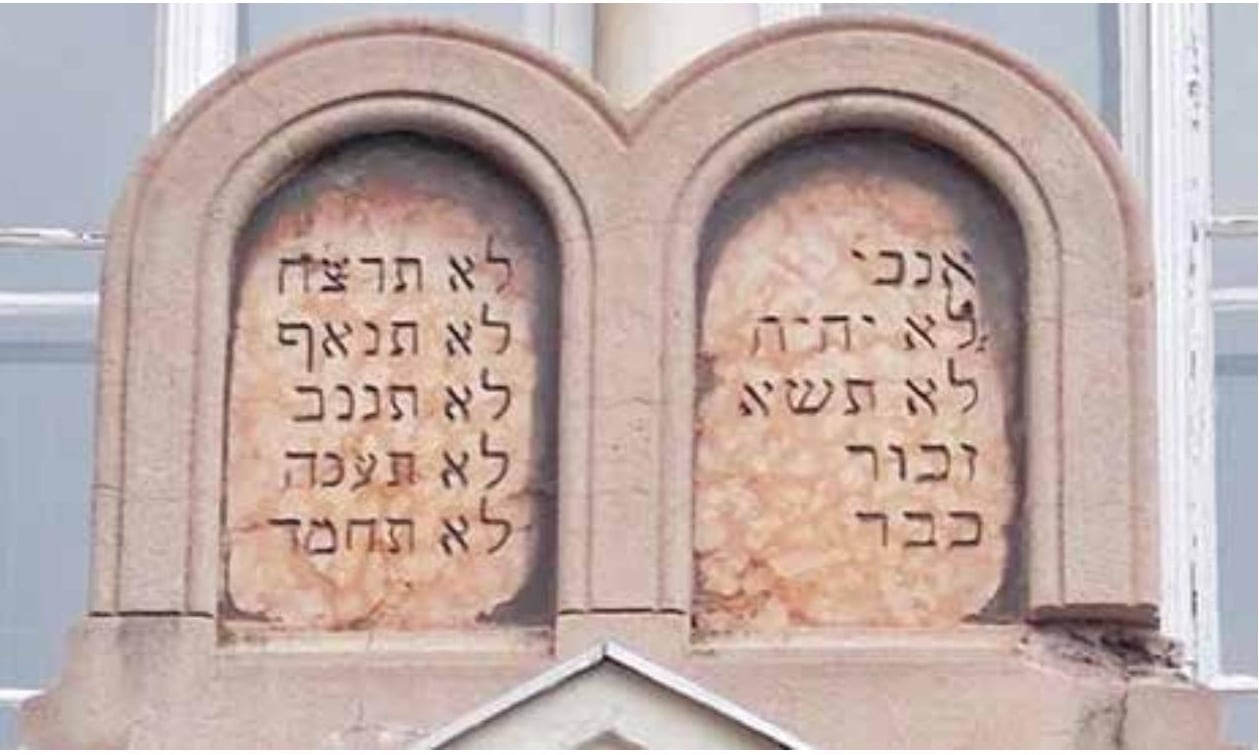
In July 2001, Chief Justice Roy Moore of the Alabama Supreme Court had a massive granite monument – it weighed more than two tons – of the Ten Commandments placed in the Alabama state judicial building. Lawsuits were subsequently filed, claiming that the public display violated the U.S. Constitution’s principle of separation of religion and government. Many religious groups argued that the public display was legal. Two years after the installation, U.S. District Judge Myron Thompson ordered the monument removed.
Lehavdil, years before that incident, a more serious question was raised. Are there any halachic impediments to the public display of the Aseres HaDibros in a shul? And, incidentally, what is the true shape of the Luchos?
One can question whether displaying the Aseres HaDibros at all is appropriate. The Shulchan Aruch, in the very first siman, states that one should recite the Aseres HaDibros daily. The Mishnah Berurah says that this serves as a daily reminder of Ma’amad Har Sinai, which is a cornerstone of our faith. Nonetheless, the Rema writes that the Aseres HaDibros should only be recited privately. A public recital might lead someone to erroneously assume that the Torah comprises only the Ten Commandments. Further, the Mishnah Berurah cautions against commissioning an Aseres HaDibros display for a shul. The reasoning is the same; no one should walk away with the notion that there are only ten mitzvos in the Torah.
As far as the shape is concerned, a Gemara we learned recently (Bava Basra 14a) discusses what was in the Aron HaKodesh. Though the contents are subject to dispute, everyone agrees that the Luchos were in them. The Gemara states that the Luchos were each six tefachim wide and six tefachim long. (There are some variant texts.) The Gemara discusses how snugly they fit in the Aron in each dimension and how much room was left over. There is no mention of any space being left over due to the curvature of the Luchos. The implication is that the Luchos were square.
The Gemara refers to the length and width of the Luchos. The Tosafos Rosh questions which side of the Luchos was called the “width” and which was the “length.” How do you determine which side of a square object is called the length and which side is called the width? Evidently, it was a matter of fact that the Luchos were square. (He notes that, according to the Yerushalmi, the Luchos were rectangular. Still, the corners were square, not rounded.)
However, in the recent past, the typical pictures of the Luchos that adorned many shuls represented them with rounded tops. A certain shul in South Africa had such a representation, and one of the congregants was not pleased. He claimed that round Luchos are a non-Jewish innovation and have no place in a shul. Some wrongly assume that Michelangelo was the first person to depict the Luchos with rounded tops when he painted the Sistine Chapel. Further, the congregant reasoned, the display had the Aseres HaDibros written on the Luchos, and the congregant raised concerns about this as well.
The congregant went with a representative of the shul to ask Rav Moshe Sternbuch, shlita, who was still living in South Africa at the time, for a ruling. (Rav Sternbuch is now the Nasi of the Eidah HaChareidis of Yerushalayim and the chief of its beis din.)
Rav Sternbuch didn’t agree that round Luchos are definitively a non-Jewish innovation. He suggested that perhaps a Jewish artisan liked the look of round Luchos, so he built his display that way. Is it a conclusive fact that indeed Rembrandt was the first artist to depict the Luchos with rounded tops? Perhaps he saw a Jewish artist’s representation and just followed suit. Perhaps it was indeed Rembrandt’s own inspiration, but a Jewish artist independently came up with the same idea. Michelangelo actually depicted the Luchos with square tops.
Various sources suggested that the inspiration to make the tops of the Luchos rounded might have come from a verse in Mishlei. The verse (3:3) states, “Write them on the Luchos of your heart.” Perhaps therefore the tops of the Luchos were rounded to somewhat resemble a heart. Of course, just making the Luchos curved on top does not make them actually resemble a heart, but the universal heart symbol, which it does somewhat resemble, can be traced back to the 1400s.
Even if the innovation was introduced by a gentile, in any case, the Luchos in shuls aren’t scale models; they are just a rough representation. They are imprecise models in many ways, so what’s the big deal if they deviate from the originals with their rounded tops, as well?
Moreover, recent research has uncovered an illustrated handwritten Machzor from 700 years ago. This German manuscript depicts the Luchos as rounded. There is no reason to believe at this point that the rounded innovation was the work of a gentile.
In regard to the public display of the Aseres HaDibros, Rav Sternbuch didn’t feel that it was much of a problem, either. The situation mentioned in the Mishnah Berurah is having the Aseres HaDibros displayed by itself; that it can lead an observer to wonder why the Aseres HaDibros is given more prominence than any other section of the Torah. But in regard to a Luchos display, the intent is to display an artistic rendition of the Luchos. To complete that image, the Aseres HaDibros are written on it. They are just being used to complete an artistic creation of the Luchos in particular. The observer will see that it is just a work of art. (Further, one can argue that the Aseres HaDibros are extremely abbreviated on the Luchos artwork. It is clear then that it is just for artwork. In the Mishnah Berurah’s case, the entire Aseres HaDibros is spelled out.)
Still, for the sake of peace in the shul, Rav Sternbuch recommended that a craftsman be hired to square off the round edges of the Luchos. He commented that everything that is done for the tzibbur should preferably be done in a way that is agreeable to all. But he cautioned against anyone else protesting about Luchos with a rounded top, something that has widespread acceptance in Klal Yisrael. Still, initially, if one is making such a Luchos display, the corners should preferably be square, as Chazal say they were.
When ordering new artwork for your shul, be sure to speak with your rav first, because there are those who disagree with Rav Sternbuch, shlita (including, apparently, U.S. District Judge Myron Thompson).
Stories in this article (1)
Questions on this article
Rabbi Avrohom Sebrow
Rebbe at Yeshiva Ateres Shimon in Far Rockaway. He leads the Daf Yomi chaburah at Eitz Chayim of Dogwood Park in West Hempstead, and writes “Delving into the Daf” each week for The Jewish Home.
About and contact