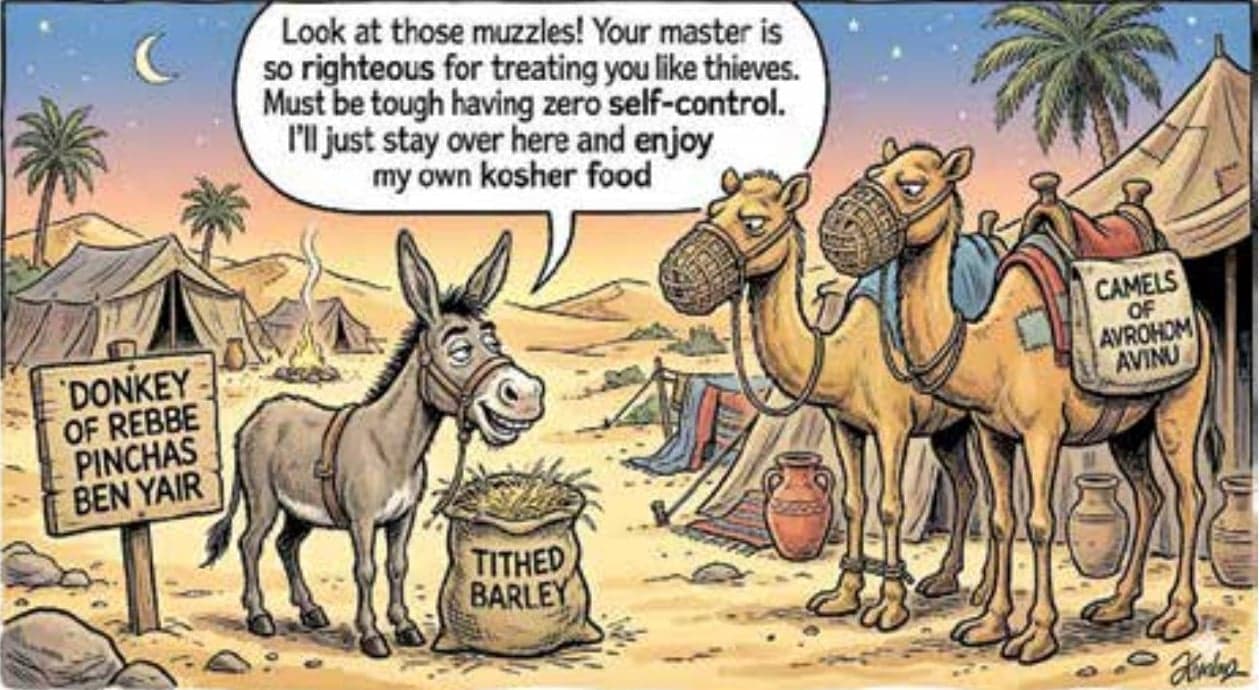
The Gemara in Chullin (7a) records the remarkable journey of Rabbi Pinchas ben Yair as he traveled to redeem captives. Along the way, he arrived at an inn where his donkey was offered barley. Despite being hungry, the donkey refused to eat. The innkeepers sifted and cleaned the barley multiple times, but the animal still stubbornly abstained.
Finally, Rabbi Pinchas suggested that perhaps the barley had not been tithed. The moment the innkeepers separated the ma’aser, the donkey happily began to eat. The Gemara uses this famous incident to establish a sweeping principle: if Hashem does not allow a pitfall to occur through the animals of the righteous, He certainly will not allow the righteous themselves to stumble into sin.
This moving account brings to light a compelling inquiry.
The Midrash’s Unanswered Question
In Parshas Chayei Sara, Rashi notes twice that the camels of Avraham Avinu were muzzled. Early in the parsha, he points out that Avraham’s camels were recognizably different from others precisely because they wore these muzzles to prevent them from grazing in other people’s fields. Later, when Eliezer arrives at the house of Lavan, the pasuk says “vayifatach,” which Rashi, citing the Midrash, explains means that Eliezer finally undid their muzzles.
The Midrash raises a glaring question: If the donkey of Rabbi Pinchas ben Yair naturally refused to eat untithed grain, how could it be that the camels of Avraham Avinu would eagerly nosh on stolen food from a stranger’s field? Avraham Avinu was certainly greater than Rabbi Pinchas ben Yair, so why was it necessary to physically muzzle his camels? Wouldn’t his sheer righteousness prevent his animals from eating stolen food?
Somewhat surprisingly, the Midrash leaves this question hanging in the air without an answer. Naturally, the commentaries step in to fill the void.
Four Ways to Defend the Camels
1. The Ramban suggests that the Midrash viewed this question as so unanswerable that it actually rejects the interpretation that “vayifatach” means Eliezer undid the muzzles. Rather, the camels were harnessed to one another, and Eliezer simply unknotted the ropes to make them comfortable, or perhaps he undid the knots tying their saddles. In truth, Avraham Avinu’s camels weren’t muzzled at all! Because the question is so powerful, it is self-understood that the camels didn’t need them.
2. The Maharzu offers a different distinction: Of course, the specific animal Avraham rode upon would refrain from eating stolen grain, just like Rabbi Pinchas ben Yair’s donkey. But this spiritual protection is limited strictly to the animal the tzaddik is actively riding. It doesn’t offer blanket coverage for his entire fleet of camels.
3. Rabbi Eliyahu Mizrachi posits that Avraham Avinu’s camels absolutely would have followed the same pious conduct as the famous donkey. However, there is a strict rule in the Torah: we do not rely on miracles. Even though the camels would not have actually eaten stolen grain, Avraham took natural pains to ensure it didn’t happen.
4. The Yeriyos Shlomo agrees that the camels wouldn’t have eaten the grain, but suggests Avraham muzzled them for educational purposes, to teach others that they should muzzle their own animals. Alternatively, it was to avoid maris ayin; onlookers might not realize Avraham’s animals were divinely protected and might suspect him of unscrupulous behavior.
The Elephant in the Room
However, all this talk of camels and donkeys ignores the elephant in the room: How are we to understand the story of Rabbi Pinchas ben Yair in the first place? Was there actually something special about his donkey, or was it just a run-of-the-mill pack animal?
The Maharsha takes the position that it was just an ordinary donkey. Hashem miraculously prevented it from eating the untithed produce simply because it would have reflected poorly on its holy owner to be fed un-kosher grain. As proof, the Maharsha notes that the Gemara actually asks why the donkey couldn’t eat it, given that the grain was only demai (doubtfully untithed), and the halacha allows one to feed demai to animals. If the donkey was some sort of spiritual genius, it could have known for certain that the grain was completely untithed! Since the Gemara has to resort to other answers, it proves the donkey had no special intuition.
The Maharsha then adds a highly enigmatic comment. He writes that, with his assertion, we can answer the “World’s Question”: Why didn’t the donkey just separate the ma’aser itself? While donkeys obviously can’t speak, the Gemara introduces a concept where one can mentally designate ma’aser by looking at one side of a pile and eating from the other. Why didn’t the donkey just do that? Because, the Maharsha concludes, it was just a regular donkey!
(As a humorous aside, Rav Moshe Feinstein, zt”l, reportedly felt that the suggestion of a donkey mentally separating tithes was so preposterous that a rogue student must have snuck that line into the Maharsha’s writings!)
A Very Special Donkey
Other commentators, however, push back. The Mahadura Basra and Tiferes Yaakov disagree with the “ordinary donkey” theory. Tosafos notes that the rule that Hashem protects tzaddikim from inadvertent sins is largely limited to the sin of consuming forbidden foods. (For example, Rabbi Yishmael inadvertently readjusted a wick on Shabbos, proving that mistakes in other areas of halacha can happen to the righteous). There is something uniquely spiritually damaging about eating forbidden food that warrants special divine intervention. But according to the Maharsha, Rabbi Pinchas ben Yair wasn’t the one eating – he was just letting his animal eat. This appears to conflict with the specific principle established by Tosafos, which holds that divine protection for a tzaddik is primarily reserved for instances involving their own personal consumption of non-kosher food.
Furthermore, Tosfos cite a Yerushalmi, which addresses the same dilemma found in the Bavli: why was the animal restricted if feeding demai to livestock is generally permitted? The Yerushalmi offers a distinct resolution, explicitly noting that the donkey adopted a personal stringency for its own conduct! This suggests the animal was endowed with an inherent spiritual awareness.
Finally, the Gemara in Shabbos (112b) states: “If the earlier authorities were like angels, then we are human beings. If the first ones were like human beings, then we are like donkeys, and not like the donkey of Rabbi Pinchas ben Yair.”
Clearly, this was no ordinary beast of burden. Indeed, some kabbalistic sources opine that the donkey was actually a gilgul of Yishmael ben Avraham, who did teshuva at the end of his life!
The Be’er BaSadeh notes that if we accept that the donkey was an extraordinary, spiritually elevated creature, the Midrash’s unanswered question about Avraham’s camels is perfectly resolved. Typical animals, even those owned by the great Avraham Avinu, operate by the laws of nature and require muzzles to keep them from grazing in foreign fields. The donkey of Rabbi Pinchas ben Yair wasn’t the rule; it was the ultimate, miraculous exception.
Maggid shiur and Rebbe at Yeshiva Ateres Shimon in Far Rockaway. He leads the Daf Yomi chaburah at Eitz Chayim of Dogwood Park in West Hempstead, and writes “Delving into the Daf” each week for The Jewish Home.