Bite Your Tongue
Attending a yom tov seudah and spotting an inviting platter of beef tongue on the table is the ultimate test of fortitude. Your mind immediately starts wondering if taking a slice means entering into a mutual tasting…
Mitzvos
Shemittah, terumos and maasros, orlah and the other mitzvos of the Land.
Attending a yom tov seudah and spotting an inviting platter of beef tongue on the table is the ultimate test of fortitude. Your mind immediately starts wondering if taking a slice means entering into a mutual tasting…
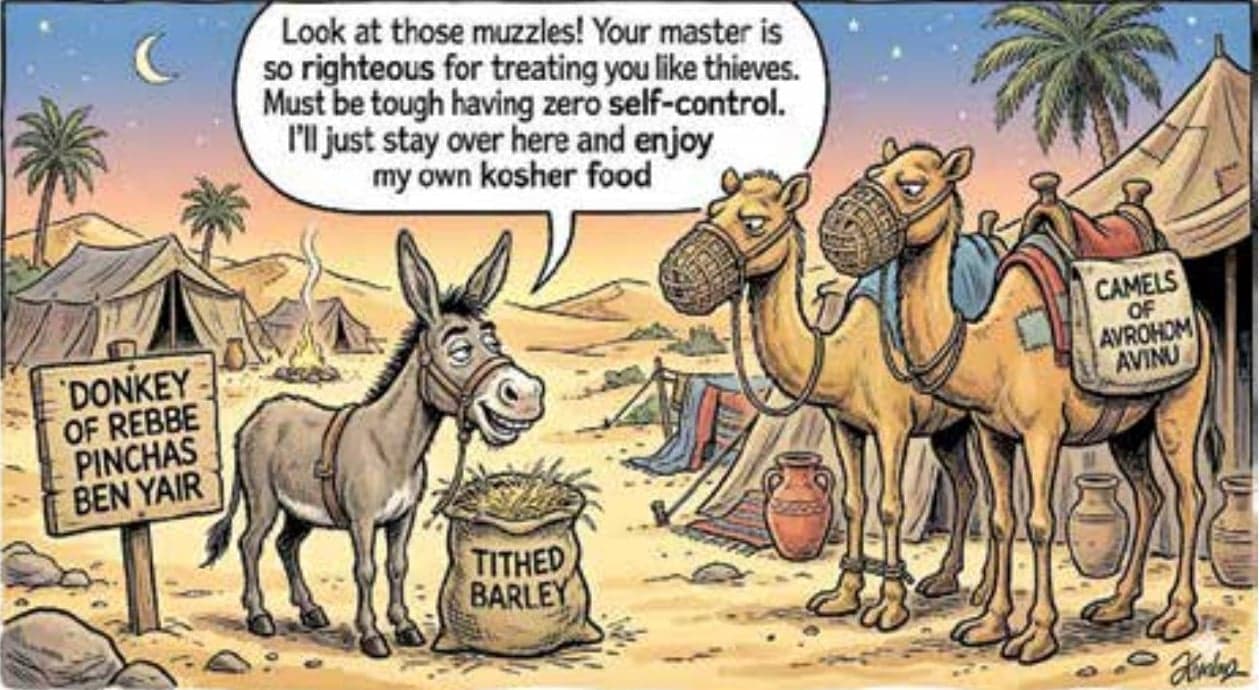
The Gemara in Chullin (7a) records the remarkable journey of Rabbi Pinchas ben Yair as he traveled to redeem captives. Along the way, he arrived at an inn where his donkey was offered barley.
My son came home with a questionnaire his rebbe had distributed. The students were asked to indicate their family’s minhagim regarding a wide range of practices at the Seder.
(Translated by Rabbi Avrohom Sebrow – Email [email protected] for sources) Rav Chaim Kanievsky zt”l was renowned for his concise, often one-word answers to halachic questions.
The Waze app has a crucial safety feature: it prohibits drivers from typing instructions while the vehicle is in motion, allowing only voice commands.
With Rosh Hashanah upon us, Jewish retailers stock new fruits for us to enjoy. An interesting halacha related to fruits, one to which we don’t give much thought to, is orlah.
Every once in a while, one reads an article that is life-changing. There may be a halacha article that raises important points the reader was not aware of.
One fine erev Shabbos, Rebbe Yannai was anxiously waiting for a gift of fruit to arrive. Every erev Shabbos without fail, an employee who worked in his field would dutifully bring a gift of fruit to show his…
The Torah awarded kohanim with terumah gifts. After terumah was separated from freshly grown Israeli produce, the farmer would separate 10% of what remained and give that to a Levi. This is termed Ma’aser Rishon.
The Gemara (Sukkah 44a) relates an enigmatic episode: A wealthy man approached Rebbe Elazar Bar Tzadok and told him that he owns villages, vineyards, and olive orchards.
On his way to redeem captives, Rabbi Pinchas ben Yair's donkey refuses untithed barley until the innkeepers separate maaser, teaching that Hashem guards the righteous.
A rich landowner asks Rabbi Elazar bar Tzadok about Shemittah olives used as wages, then rushes away mid-conversation to stop it, deeply impressing the sage.
Rabbi Akiva has a farmer move his garden entrance beside a cemetery, so the kohen Rabbi Elazar ben Azaryah can no longer collect Ma'aser Rishon there.