Moon Stones
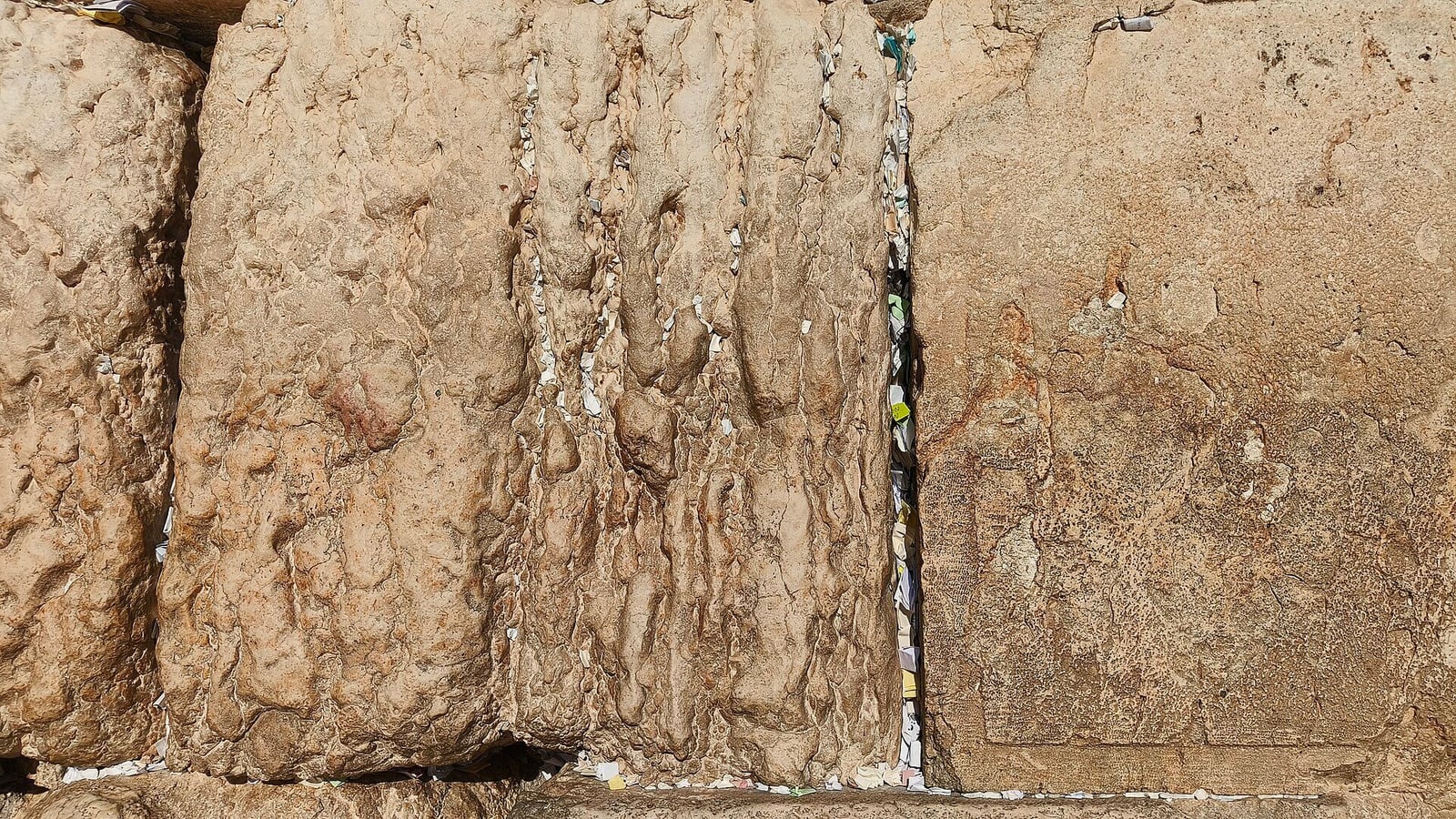
Last week, I discussed the prohibition of taking stones from the Kosel. Many readers likely assumed that it was a bizarre and irrelevant topic. (Not that it would make a difference to me anyway; I like writing about the obscure.) However, I have since been told that two people who I’m familiar with have such stones.
One individual related to me how he happened to come into possession of such stones. Archaeologists were excavating near the Kosel. During the dig, many stone fragments were uncovered. However, the archaeologists were only interested in the large pieces of stone. My friend was free to take the smaller ones. There is no concrete proof, so to speak, that these stones came from the Kosel or other Har HaBayis walls, but it was a distinct possibility. The following question was sent to R’ Dovid Feinstein, shlita: What should one do if one already has fragments of the Kosel in his possession? The answer: He should throw them into the ocean or other large body of water. It is forbidden to derive any benefit from the stones, so it’s better to not keep around an object that can easily lead one to a Biblical prohibition. As a reminder, we quoted the Igros Moshe last week that even displaying the stones as one would display an antique constitutes me’ilah, deriving unauthorized benefit from consecrated property.
This week my creative juices weren’t flowing and I was trying to find an interesting topic that relates to the daf, but I couldn’t come up with any. The Shas Lublin, in the Aliba D’Hilchasa section, quotes a teshuvah from R’ Moshe on one daf this week regarding the prohibition of yichud. I think that tying that teshuvah to the daf is a bit of a stretch—after all, only passing reference is made to yichud in our Gemara—but it’s not worse than some feeble correlations that I’ve made in the past. So I decided to use it.
A shochet sent the following question to R’ Moshe (see Igros Moshe E.H. 3:19): He worked at a slaughterhouse that was not surrounded by a large Jewish community. However, there was an elderly couple that permitted him to eat and sleep by them. The husband passed away so the widow lived alone. Her son, though, would take her to his house every night so she could sleep there. The question was, is the shochet permitted to sleep in the widow’s house at night? In reality, there is no issur of yichud, since he in fact is the only one present. Perhaps, though, it should be forbidden because of ma’aras ayin or chashad. Maybe not everyone would realize that the woman goes home every night, and they might assume that he is violating the issur of yichud, being secluded with a woman who is not his wife. His only other choice was to sleep on the cold, wet slaughterhouse floor. (Apparently, Motel 6 hadn’t opened yet in 1965.)
R’ Moshe permitted him to sleep at the woman’s house. One of his reasons was that in general there are several ways to escape the issur of yichud. Having other people also sleep in the house is one possible way. Since there are permissible ways for him to sleep at the house of the widow, there is no problem of chashad. People will assume that he is sleeping there in a permissible fashion—which is the truth, in fact, since the woman no longer sleeps there. R’ Moshe cites a Gemara in Avodah Zarah to prove that when dealing with the issur of chashad we take into account what people’s perception will be: We don’t blindly forbid something because maybe someone will have a suspicion; there has to be a good reason to assume that onlookers might suspect an avierah is being committed before we forbid something on account of chashad.
The truth is that I have wanted to write about the following for some time but I kept putting it off until I would be able to deliver a comprehensive article on the subject. Since I have not done that, and I can tie this into the article, I will write what I have researched. (Please ask your rav for a final p’sak).
The Chochmas Adam writes (k’lal 86:3) that there is a Biblical prohibition against making solid models or statues of a man or an angel. He writes that this prohibition extends to making pictures of the sun, moon, and stars as well, but with one important distinction: The prohibition against making a form of a man only applies to a 3-D form, whereas the injunction against pictures of the sun and moon would apply not only to a solid model, but even to two-dimensional flat, realistic drawings (or photos). Many schools encourage their young students to only draw partial pictures of the sun, as this is permitted by many authorities. (This is accomplished by putting the sun in the corner or top of the page and only drawing the part of the sun that “extends” on the page. One could argue that children’s pictures do not resemble the sun and the moon, and this indeed would be a basis for leniency.)
However, this discussion was so far limited to forming these images. Owning them is a different story. The Chochmas Adam quotes the Shach as stating that one should not even own statues of a man, the reason being chashad; someone might assume that the statue is being used as an idol.
If you want to save yourselves a lot of money, you can stop reading after this paragraph! When your child asks for an American Girl doll for Chanukah, tell her, “It’s treif! It’s assur! I wouldn’t dare bring such avodah zarah into my house. Don’t you know the Shach says that you can’t own human forms! What is a doll, if not a baby statue!” She might say, “But Daddy, these dolls are not anatomically correct! Can’t we be meikil?” So you’ll respond, “My little girl, you have been reading too much ArtScroll! True, the bodies may not be anatomically correct, but the faces are and there is an opinion that the prohibition applies to just forms of faces!” Defeated, your little girl will whimper to her room. (My wife, on the other hand takes a much simpler approach: “We won’t have such American sh’tus in our house!”)
Hopefully, your daughter won’t get her hands on the rest of this article. The Chochmas Adam, after quoting the Shach, continues and says, “It appears to me that nowadays owning human forms is permitted.” No one will suspect an individual of owning a human form for idolatry, as these forms are no longer worshipped. If that was said back in the Chochmas Adam’s time, it would certainly apply to today’s dolls. No one would assume that one owns a Cabbage Patch Kid for idolatrous purposes. (There still may be a problem, however, of manufacturing dolls or re-attaching a part of a doll that came off; one should seek halachic guidance.)
The Nachal Eshkol writes the same reasoning regarding a similar issue. Apparently, the wealthy men of his times had human forms on their stoves. He writes that since these forms are no longer worshipped, one is permitted to own them. No one would become suspicious that you practice idolatry when they see that your oven knobs are shaped like human heads. (They may have some other suspicions, though...) The Nachal Eshkol then makes a remark similar to R’ Moshe’s. Chashad prohibitions are based on current and actual circumstances. The rabbis only forbade owning these type of items back in their days, because then there was actually a basis for suspicion. However, even back then, the rabbis gave examples of where owning these would not arouse suspicion (e.g., Torah purposes and public displays.) Therefore, if a reasonable person nowadays would not have a basis for suspicion of idolatry, we do not have to worry about the issur of chashad (even if in earlier times we did).
To clarify, there are two prohibitions:
1. A Biblical prohibition against creating human forms and pictures of the sun and moon. That remains in full force regardless of current circumstances.
2. A rabbinic prohibition against owning human forms and pictures of the sun and the moon. This only applies where there is basis for suspicion that one is using these items for idolatrous purposes.
Therefore, R’ Dovid Feinsten, shlita, ruled that one is permitted to own books that have pictures of the sun and the moon, as no one would ever think that he is using the pictures in the book for idolatry. This is the basis for our schools and yeshivos using science books that have these pictures.
Just to come full circle, is there any prohibition in keeping rocks from the moon? Does anyone out there worship moon stones?
More Gemara stories
Questions on this article

Rabbi Avrohom Sebrow
Rebbe at Yeshiva Ateres Shimon in Far Rockaway. He leads the Daf Yomi chaburah at Eitz Chayim of Dogwood Park in West Hempstead, and writes “Delving into the Daf” each week for The Jewish Home.
About and contact