In the bustling city of Shushan, two young boys, Eli and Daniel, raced through the crowded marketplace.
“I heard Father say that Haman rides through the streets today,” Eli panted, his dark curls bouncing as he ran. “He’s second only to King Achashverosh himself!”
Daniel responded “And they say everyone must bow to him. Even the nobles!”
The boys skidded to a stop as they reached the grand gate of the King’s palace. Peeking from behind one of the pillars, Eli pointed. “Look! There he is!”
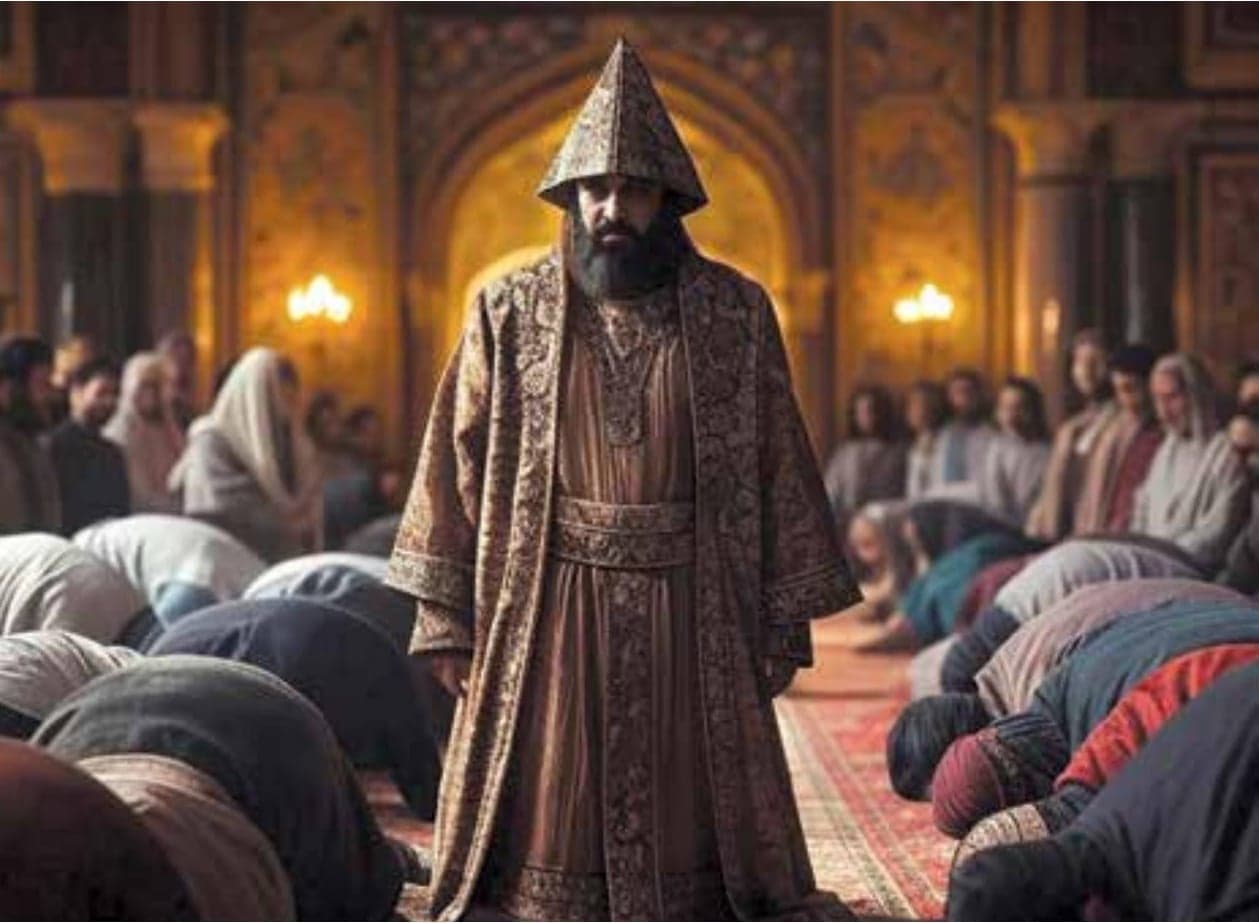
A crowd had gathered. At its center was Haman, his robes rich and flowing, adorned with jewels that sparkled like stars. His chin was lifted high, a smug smile curling at his lips as the people bowed low, their heads nearly touching the ground.
But amidst the sea of bowed figures, one man stood tall and unyielding. His face was solemn, his back straight, and his eyes focused forward, unwavering.
“That’s Mordechai HaTzaddik!” Daniel whispered, gripping Eli’s arm. “He’s one of the King’s advisors and a rebbe at our yeshiva.”
The boys watched, their hearts thudding. The noise of the crowd dimmed, and an eerie silence blanketed the area. Haman’s smile faded, his eyes narrowing as he turned to see who dared defy him. His gaze locked on Mordechai, who stood firm, his expression calm and resolute.
Haman’s face flushed with fury. “Why do you not bow before me?” he demanded, his voice echoing off the palace walls.
Mordechai’s voice was steady, clear enough for all to hear. “I am a Jew, and I bow only to the Al-mighty.”
The crowd gasped. Eli’s and Daniel’s eyes widened, a chill running down their spines. Haman’s fists clenched, his knuckles turning white. For a moment, the world seemed to hold its breath.
Then, Haman’s lips curled into a wicked smile. “You will pay for this insolence,” he hissed, his voice dripping with malice.
Eli and Daniel then engaged in a whispered conversation.
Eli: Why is Mordechai refusing to bow down to Haman?
Daniel: The Mishna in Sanhedrin states that bowing can be a form of Avoda Zara. If that’s the case, then bowing to Haman should be forbidden as well.
Eli: But the Gemara in Sanhedrin (61b) clearly states that bowing as a sign of respect to another person is permissible. Why would honoring Haman be an issue?
Daniel: Honoring him isn’t the problem – it’s the fact that Haman declared himself a deity (Megillah 19). That makes bowing to him a direct issue of Avoda Zara.
Eli: Mordechai could simply bow with the intention of showing respect and not worshipping him. That way, it wouldn’t really be Avoda Zara.
Daniel: Abaye discusses this exact scenario. He says that serving an idol out of fear or respect for another person is still considered Avoda Zara. If someone mistakenly thought this was allowed and did it accidentally, they would need to bring a Korban Chattas.
Eli: True, but Rava disagrees. Rava holds that worshipping an idol for ulterior motives does not count as Avoda Zara unless the person truly accepts it as a god. Since we follow Rava’s rulings in halacha, Mordechai should technically be allowed to bow to Haman out of fear.
Daniel: That’s outrageous! The halacha is clear – one must never transgress the “Big Three” sins, even under threat of death. Are you suggesting Rava disagrees with this fundamental rule?
Eli: You raise a valid concern. But in Avoda Zara 54a, Rava states that one must only sacrifice their life if Avoda Zara is worshipped publicly. If worshipped in private, it is permitted to save one’s life. Since Mordechai was at the palace gates – a private setting without ten Jews present – he could have bowed without violating this law.
Daniel: That’s not how we rule. The prevailing opinion is that one must die rather than worship Avoda Zara, even privately. Tosafos even explains that Rava wasn’t presenting his own view – he was merely explaining another sage’s position. Mordechai, therefore, could not bow, even at the palace gates.
Eli: But this situation is unique. Everyone was bowing to Haman out of fear. Everyone knew it wasn’t genuine. The prohibition against bowing to Avoda Zara applies when the person is the only one who knows it’s a sham. Here, the entire nation was pretending, so shouldn’t Mordechai have been allowed to do the same?
Daniel: Hmm. That’s an interesting point. Tosafos does suggest something along those lines. But consider this – Haman was wearing idols around his neck. Those were actual deities that people worshipped. That could explain why Mordechai refused to bow.
Eli: But did you see Rav Oppenheim’s view? He rules that bowing to a government official wearing idols is permissible. It is clear that the show of respect is meant for the official and not the idols.
Daniel: Maybe so, but in the future, the Terumas HaDeshen will be written, and it will disagree. In fact, it will cite Mordechai’s refusal as proof that one may not bow to an official wearing idols. That’s probably why Mordechai refused.
Eli: That’s one interpretation. But are you absolutely certain Haman was wearing idols? Those gaudy accessories around his neck look less like idols and more like a desperate fashion statement! Honestly, if bad fashion were a crime, Haman would have been executed long before Mordechai had a chance to annoy him! Who would wear a triangular hat?
Daniel: Tosafos offers yet another perspective. According to this view, Mordechai could have bowed, but he chose not to, for the sake of making a Kiddush Hashem. This is similar to a story about two brothers who were threatened with death unless they drank forbidden wine. Though they could have deceived their captors by drinking water from red-colored glasses, they chose martyrdom rather than create the appearance of violating Jewish law. Mordechai, too, was willing to risk his life to avoid even the perception of idolatry.
Eli: That makes sense. Rava in Megillah (13) notes that many Jews complain about Mordechai’s actions. They feel he should bow instead of provoking Haman unnecessarily. It seems like that may have a point.
Daniel: Exactly! HaBochur Shlomo, shlit”a, even cites support for this view from the Gra. The Gra will explain that Mordechai’s intense weeping upon hearing Haman’s eventual decree will stem from his own guilt – he will feel that his refusal to bow had triggered Haman’s wrath against the Jewish people.
Eli: I have a feeling this will all work out well, and we’ll end up celebrating this moment.
Maggid shiur and Rebbe at Yeshiva Ateres Shimon in Far Rockaway. He leads the Daf Yomi chaburah at Eitz Chayim of Dogwood Park in West Hempstead, and writes “Delving into the Daf” each week for The Jewish Home.