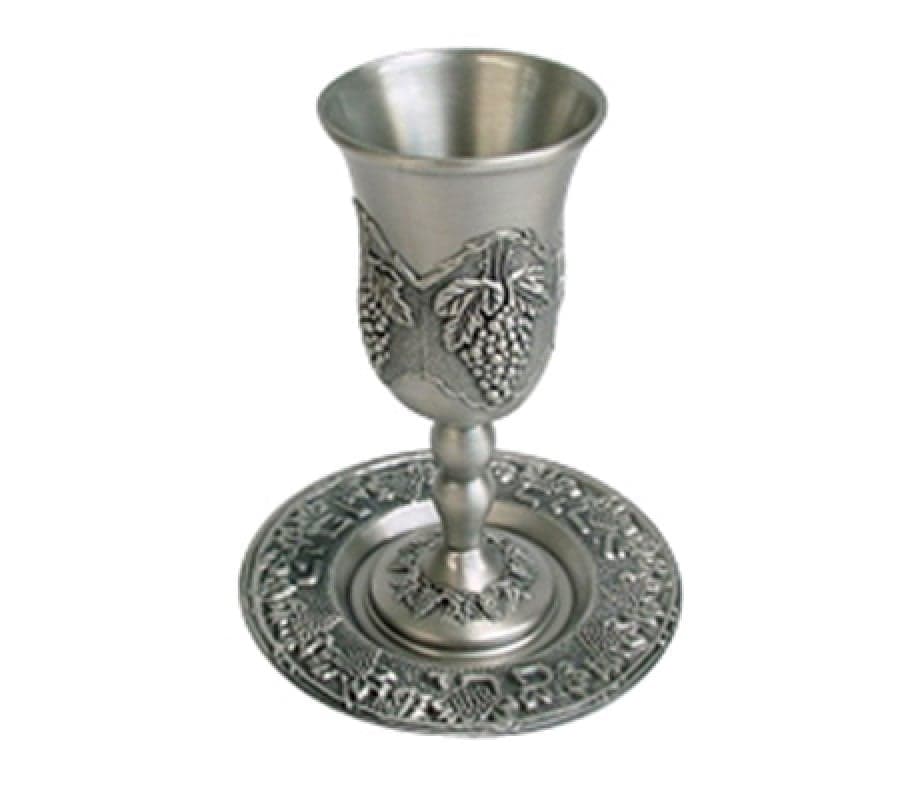
Being of Litvish stock, I always insist on making Kiddush on grape juice or wine. However, occasionally I attend a Kiddush where wine and grape juice are hard to come by. Those of the chassidic persuasion have no problem filling up a schnapps cup with Black Label and making Kiddush on one ounce of that warming liquid.
There are two issues that need to be settled. The first is the appropriateness of using anything other than grape juice or wine. The Shulchan Aruch (272:9) writes, “In a place where wine is not commonly available, there are those that say one can make Kiddush on beer and other [significant] drinks . . . And there are those that say that you can’t.”
The Rosh’s view is that on Friday night, if wine or grape juice is not available, one should make Kiddush on challah; during the day, if wine or grape juice is unavailable, one should use chamar medinah—significant drinks. We follow the Rosh’s opinion. The Mishnah Berurah (29) adds in explanation of the Rosh’s opinion, “However, where wine is available one should certainly use it.”
The halachah seems to be clear: One should not use beer or schnapps for Kiddush if wine is available. Chalk one up for the Litvaks.
But the Mishnah Berurah continues, “However, in our countries, where wine is expensive and most social drinking is with other drinks, even the gedolim are not accustomed to using wine for Kiddush on Shabbos day, and they rely on those that are lenient. Kiddush during the day is only a rabbinic mitzvah (and therefore the halachah is more lenient). Someone who nevertheless makes Kiddush during the day on wine is definitely doing the mitzvah in the best manner.”
In the next paragraph, the Mishnah Berurah is even more lenient. He rules that if one prefers whiskey to wine, he may use that l’chatchilah for Kiddush during the day. OK, so chalk this one up for the chassidim.
However, the Mishnah Berurah seems to be permitting this only in his country where wine was expensive. Nowadays, where wine is readily available and affordable, there seems to be no basis to use anything besides wine or grape juice. Rav Simcha Bunim Cohen raises this question in his sefer, Radiance of Shabbos (chapter 18, footnote 4). He notes that it is the custom of many to make Kiddush on schnapps even nowadays in the United States. He concludes that there are other opinions that differ with the Mishnah Berurah and many follow those variant opinions. There were tzaddikim who instructed their followers to specifically recite Kiddush on liquor on Shabbos day (ibid. footnote 7).
There is some discussion as to what drinks qualify for this leniency. Beer and liquor definitely qualify. Seek guidance from your rav about other drinks, such as orange juice, coffee, milk, and soda.
However, there is an additional caveat to using liquor for Kiddush on Shabbos day. The Mishnah Berurah writes that if someone uses liquor for Kiddush, “he must be careful to use a cup that holds a revi’is and to drink from it a malei lugmav, which is most of a revi’is.” There is some dispute as to what exactly the shiur of a revi’is is. The smallest shiur is 2.9 ounces; 3.3 ounces is probably more mainstream. When it comes to Kiddush on Friday night, we are generally more stringent and use a cup that holds around 4.5 ounces.
The Mishnah Berurah does not even quote anyone who disputes the halachah that the cup must hold a revi’is. So when reciting Kiddush during the day on schnapps, one has to use a cup that holds at least three ounces. Further, one must drink at least 1.6 ounces, as this constitutes malei lugmav, also known as a cheekful. For those of you who enjoy schnapps, this should not be a tough halachah to swallow.
The Mishnah Berurah offers an alternative to drinking this amount, although he does not consider this solution preferable. You can distribute the schnapps to other people who are being yotzei with your Kiddush. As long as 1.6 ounces of the schnapps from the Kiddush cup ends up being consumed by the Kiddush participants, you have fulfilled your Kiddush obligation. Once again, this is considered b’di’eved, because initially the person making Kiddush should drink the entire malei lugmav himself.
However, the Mishnah Berurah adds an interesting addendum. The halachah is that the entire malei lugmav must be drunk in the time span of k’dei achilas p’ras, the time it takes a person to eat a piece of bread. There are various opinions about how long this is, and the range is approximately between two and four minutes. The Mishnah Berurah writes that if someone wishes to employ the leniency of having several people drink schnapps to constitute a malei lugmav, they all must finish their schnapps within the timespan of the same k’dei achilas p’ras.
The Afikei Yam finds this halachah bizarre. It is one thing to say that one person must consume a certain amount within a limited time to qualify as one act of consumption. If a person takes too long to drink or eat something, it would necessarily be deemed two distinct acts. But where several people are combining to drink the required shiur, this already consists of separate acts of drinking being performed by different people. The fact that they consumed it in the span of four minutes should be irrelevant.
However, to support the Mishnah Berurah, the Biur Halachah cites a Gemara in this week’s daf. The Gemara discusses the halachah that inappropriate intent by a kohen can invalidate a sacrifice. If, while performing one of the required procedures with the sacrificial blood, the kohen has in mind that a kezayis of the meat will be consumed after the appropriate time, the korban is invalid. The Gemara (Zevachim 31b) concludes that if the kohen had in mind that two people would each consume half a kezayis of the meat after the appropriate time, the korban is also disqualified.
If we were to follow the Afikei Yam’s logic cited above, the shiur of k’dei achilas p’ras should not be relevant to this latter halachah, since two separate intended acts of eating are involved by two different people — and the shiur of k’dei achilas p’ras is applied only to determine whether all the food consumed can be considered one act of eating. Yet the Gemara considers k’dei achilas p’ras to be a factor even in this case.
This proves that k’dei achilas p’ras is relevant even when two people are consuming a requisite shiur. Hence, the Mishnah Berurah has support for his halachah that even if two people are drinking the malei lugmav from Kiddush, they should do so within 2 to 4 minutes.
As we mentioned, the Mishnah Berurah rules unequivocally that the cup used for Kiddush must contain a minimum of a revi’is, or around three ounces of liquid. There is the opinion of the Taz, however, who holds that the shiur of revi’is is only applicable to wine or beer. When it comes to schnapps, we consider the amount that is usually drunk in that locale. A serving of schnapps is a shot, or about one ounce. Consequently, he holds that a 1 ounce cup can be used for Kiddush if schnapps is being used. This opinion was followed by numerous chassidic masters. Those whose fathers or rebbeim followed the opinion of the Taz may certainly follow it. Others should make Kiddush using a cup that holds at least three ounces.
There is yet another issue on this topic. In Europe, when Kiddush was recited using a 1 ounce cup, it was made of metal or glass. There is a halachic controversy whether one may use a disposable plastic cup for Kiddush. It is possible that a plastic shot glass is even worse than a disposable 7-oz. cup, because plastic cups may be used a few times before they are disposed of, whereas plastic shot glasses are usually used only once. It seems that the custom now is to be lenient even with regard to a plastic 1 ounce shot glass.
Maggid shiur and Rebbe at Yeshiva Ateres Shimon in Far Rockaway. He leads the Daf Yomi chaburah at Eitz Chayim of Dogwood Park in West Hempstead, and writes “Delving into the Daf” each week for The Jewish Home.